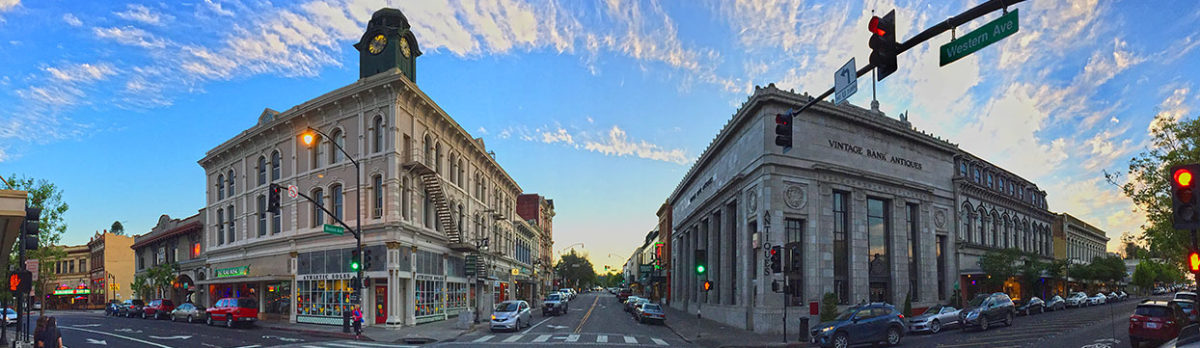
The Union Hotel 1852-1902

Entrance to the Union Hotel Beer Hall, Main and B streets, c. 1892, with the saloon proprietor John Hermer most likely the man with the white beard (Sonoma County Library)

In 1852, two brothers from Germany, Herman and John Schierhold, purchased a lot at the southwest corner of Main Street and today’s Western Avenue. Using timber they hauled down from Freestone, they built a two-story hotel. A classic German “gasthaus,” it included a bar and billiards room on the bottom floor, with six rooms upstairs for boarders and guests upstairs.[1]

The Schierholds’ gasthaus became an anchor for Petaluma’s growing German merchant district. By the mid-1870s German-owned businesses extended along the west side of lower Main Street from Western Avenue to Center Park (today’s Historic Chinatown Park).

They included Heinrich Matthies’ Continental Hotel and John Pfau’s Centennial Building (today’s Land Mart), which featured a German saloon, a livery stable, Heinrich Dortmund’s Wine Depot, and the German Druids Hall.

German-owned Continental Hotel and beside it the Centennial Building, 1890s (courtesy of Dan Brown Collection)

Two blocks away on Fourth Street between B and C streets sat Turn Verein, or Turner Hall, which served as a German social club, hosting lectures, social events, dances, festivals, and musical performances.[1a]

Turn Verein or Turner Hall at Fourth Street between B and C streets, built 1875 (Petaluma Historical Library & Museum and Petaluma Courier)

In 1855, the Schierholds sold their gasthaus to a woman named Rosanna Loftus who renamed it the Farmers’ Hotel. A married woman, Loftus purchased the hotel as a “sole trader,” which meant she was legally able to own and operate her own business independent of her husband.[2]

1855 map with arrow pointing to site of Farmers Hotel (Sonoma County Library)

Herman Schierhold went on to operate the Relief Saloon and the Capitol Saloon in town, as well as the Petaluma Brewery. The first brewery in Sonoma County, it was originally founded in 1855 by a fellow German immigrant, Fredrick Christlich.[3]

In 1858, a German named August Starke purchased the Farmers’ Hotel from Loftus, renaming it the Union Hotel & Saloon.[4] In 1866, he leased out operation of the hotel and saloon to Heinrich Matthies, who added “Deutsche Gasthaus” to the name Union Hotel.[5]

Illustration of the Union Hotel, Deutsche Gasthaus, 1885 (Map of Petaluma by William W. Elliott, Sonoma County Library)

In 1876, Petaluma’s leading capitalist John McNear purchased the hotel building and property from Starke’s widow, Frances.[6]

In 1881, McNear sold the Union Hotel building to fellow capitalist Isaac Wickersham, who moved it to property he owned at the southeastern corner of Main and B streets. That cleared the way for construction of the Masonic Lodge at the hotel’s original site on the corner of Main and Western Avenue.

Masonic Lodge at Main Street and Western Avenue, 1902 (Petlauma Historical Library & Museum)

Meanwhile, Wickersham undertook a complete rebuilding of the hotel in its new location, adding 17 new rooms.[7]

In 1889, the description “Deutsche Gasthaus” was dropped from ads for the Union Hotel by longtime operator Samuel Carstens, a Danish immigrant A German named John Hermer ran the Union Beer Hall in the hotel.[8]

Ad for Union Hotel Beer Hall, Petlauma Courier, May 24, 1892.

In 1900, a fire, suspected to be arson, badly damaged the hotel, destroying its bar and bowling alley. By that time, the hotel was owned by G.P. McNear, who leased it to Claus Struve, a German immigrant, and Jimmie Rasmussen, a Danish immigrant.[9] The hotel was restored and reopened.

In 1902, G.P. McNear’s Oriental Mills & Feed headquarters on Main Street across from Penry Park (then Hill Plaza) burned down. McNear decided to relocate his operation to the site of the Union Hotel, which sat in front of one of his grain mills (today’s Great Petaluma Mill).

He announced plans to move the Union Hotel to Third streets and C streets so that he could clear the site for his new building. A few months later, he changed his mind, and decided to tear the hotel down instead.[10] 

New G.P. McNear Feed Company Building, 1903 (Petaluma Historical Library & Museum)

So ended the legacy of a 50-year old Petaluma landmark building.


FOOTNOTES:

[1] “Local News As Condensed,” Petaluma Argus, October 3, 1902; “Built the Union Hotel,” Petaluma Courier, October 3, 1902; Note: no mention of the name of the Schierholds’ hotel found.

[1a] “Cosmopolitan Hotel,” Petaluma Argus, August 25, 1876; “Pfau’s Centennial Building,” Petaluma Argus, March 3, 1876; “Centennial Headquarters,” Petaluma Argus, July 14, 1876; “The Druids,” Petaluma Courier, December 22, 1880; “Turners’ Ball,” Petaluma Argus, January 1, 1875.

[2] Legal Sole Trader Notice, Petaluma Journal, September 22, 1855; Ad for Farmer’s Hotel, Petaluma Journal, November 20, 1855; Note: not clear if Schierholds were the owners at time of sale to Loftus.

[3] “Courierlets,” Petaluma Courier, October 22, 1884; “H. Schierhold Died Weeks Ago,” Petaluma Argus, December 22, 1905; “Petaluma Breweries,” Petaluma Argus, December 8, 1876; Note: Christlich launched the brewery with a partner named Erbe, who by 1860 had sold out his interest to Christian Theilman, who died in 1864.

[4] Ad, Sonoma County Journal, February 12, 1858: Starke converts Farmer’s Hotel to Lager Beer Saloon; “Brutal,” Sonoma County Journal, February 11, 1859: Starke’s establishment now referred to as the “Union Billiard Saloon”; Ad for Union Hotel, Sonoma County Journal, October 12, 1860.

[5] Ad for Union Hotel, Petaluma Argus, September 6, 1866. Note: by the 1870s, Matthies was also operating the Continental Hotel (“Cosmopolitan Hotel,” Petaluma Argus, August 25, 1876).

[6] “Brevities,” Petaluma Argus, October 20, 1876; “Real Estate Transactions,” Petaluma Argus, November 3, 1876.

[7] “City Improvements,” Petaluma Courier, June 1, 1881; “Housewarming,” Petaluma Argus, August 19, 1881; “Reopened,” Petaluma Courier, August 31, 1881; Ad for Union Hotel, Petaluma Argus, September 30, 1881.

[8] Last ad for Union Hotel including “Deutsche Gasthaus,” Petaluma Courier, January 30, 1889; Ad for Union Beer Hall, Petaluma Courier, May 24, 1892; “John Hirmer Dead,” Petaluma Courier, May 31, 1894.

[9] “The Union Hotel Badly Wrecked,” Petaluma Argus, July 9, 1900.

[10] “A Midnight Blaze,” Petaluma Courier, June 11, 1902; “Union Hotel to Be Moved to Third and C Streets,” Petaluma Argus, August 15, 1902; “Local News As Condensed,” Petaluma Argus, October 3, 1902.

Petaluma’s Real Main Street Video Presentation, Part II

In Part II of this video presentation sponsored by the Petaluma Historical Museum and the Sonoma County Library, historian John Sheehy explores how a diverse community of Irish, Black, and German merchants in the 19th century made Petaluma’s Main Street such a bustling melting pot.

Real Main Street Video Presentation, Part I

Part I of this video presentation series explores Petaluma’s early Jewish, Chinese, and Swiss Italian communities.

The Cosmopolitan Hotel

A snapshot history of 27 Petlauma Boulevard North

Cosmopolitan Hotel (today’s parking lot beside McNear’s Saloon), circa 1900, built in 1866 as the New York Hotel (photo courtesy of the Dan Brown Collection)

The parking lot between the Lan Mart and McNear buildings on Petaluma Boulevard has seen many incarnations since 1853, when it housed the local post office and the first doctor’s office in town.

When Dr. Samuel W. Brown rolled into town in the spring of 1852, Petaluma was a very new community. It had been established just months before by George H. Keller, a failed gold miner from Missouri.

Brown, a physician and former postmaster from Hartford, Connecticut, Brown, came west in 1849 for the gold rush, then settled in Sacramento. Keller sold him a large lot running from Lower Main Street to Kentucky Street. Here he built one of the first houses in town. It served as a home for his family, as well as an office for seeing patients.

1855 illustration of Petaluma with Dr. Samuel W. Brown’s house and office marked in red; behind Dr. Brown’s house is the first Methodist Episcopal Church at 4th & A streets; Main Street runs to the right of Dr. Brown’s house, with the two-story American Hotel in the center (illustration Sonoma County Library)

In the fall of 1853, after Brown was appointed Petaluma’s postmaster—a position first held by Keller’s 21-year old son Garret—his house also became the local post office.[i]

A strong advocate of public education, in 1856 Dr. Brown was elected president of the board of the Bowers School, the town’s only public school. Four years later, he led the campaign to replace the dilapidated schoolhouse at Fifth and B streets  in 1860 with the B Street or “Brick School,”  which occupied the site until 1911, when it was replaced by Lincoln Elementary (today converted into an office complex).[ii]

B Street School, also known as the Brick School, built 1860 at the northeast corner of B and Fifth streets (photo Petaluma Historical Library & Museum)

A co-founder of the Sonoma County Republican Party, Brown ran for State Superintendent of Public Schools on the Republican ticket in 1860, but lost. He died two years later of a sudden heart attack. The children of the Brick School made enough 10 cent donations to purchase a tombstone for his grave, upon which they had inscribed “The children’s friend.”[iii]

Following Brown’s death, his home and office—declared a “Petaluma landmark” by the local newspaper—were moved to an unknown part of town. The lot was purchased in 1866 by George L. Purdy, a blacksmith from Valley Ford, who erected the New York Hotel on the site. Three stories high with 46 rooms, the first floor was occupied by two storefronts, initially for a grocery and a shoe store.[iv]

The hotel sat in the middle of Chinatown, adjacent to Chinese dwellings and businesses. Its point of distinction was as the hotel closest to the railroad depot at Second and B streets, which served the Petaluma & Haystack Landing Railroad. The line extended two-and-a-half miles south to the steamboat dock of Haystack Landing.

Unfortunately for Purdy, just prior to the opening of his hotel, the locomotive’s boiler blew up while the train was sitting at the depot, killing four people. It was replaced with a horse-drawn train car.[v]

After three years of struggling to make ends meet, Purdy sold the hotel. It turned over a couple of times before it was purchased in 1873 by Heinrich Matthies, the owner of the Union Hotel at the nearby corner of Main Street and Western Avenue (site of today’s Masonic Lodge), which he advertised as the “Deutsches Gasthaus” (German guest house).

Union Hotel (Deutsches Gasthaus), 1885, originally located at the southwest corner of Main Street and Western Avenue, moved in 1881 to the northeast corner of Main and B Streets to make way for the new Masonic Building (Illustration form 1885 Map of Petaluma by William W. Elliott, Sonoma County Library)

In 1876 Matthies remodeled and upgraded the New York hotel, renaming it the Cosmopolitan. On the Kentucky Street side, across from where City Hall would be built in 1886, he constructed a cottage for his family to live in.[vi] He also leased 11 rooms in the upper story of the new Centennial Building next door (today’s Lan Mart building), inserting a hallway to provide passage between the two buildings.

Cosmopolitan Hotel and Centennial Building (today’s Lan Mart), 1876 (illustration Sonoma County Library)

According to local lore, those 11 rooms served as a discrete brothel for hotel guests.[vii] If true, it would have most likely been in the late 1870s and 1880s, as the hallway between the two buildings was eliminated by the early 1890s.[viii]

After Matthies’ death in 1883, the Cosmopolitan became a workingman’s boarding house.

The Cosmopolitan Hotel, circa 1910s (photo Petaluma Historical Library & Museum)

In 1919, Matthies’ son Henry, a San Francisco-based contractor, tore down the dilapidated hotel and erected a modern single story commercial building with two storefronts in its place.

The Matthies Building, 1930 (today’s parking lot beside McNear’s Saloon), featuring Bolton’s 5 cents to $1.00 Store and Alyne’s Women’s Apparel, built in 1919 (photo Petaluma Historical Library & Museum)

One storefront was occupied by Alyne’s, a women’s apparel shop operated by Alyne Thomas, the daughter of local grocery merchant Achille Kahn. The other was occupied by F.W. Woolworth’s department store. After Woolworth’s moved to the new Phoenix Building on Main Street in 1929, they were replaced by a discount shop called Bolton’s 5 cents to $1.00 Store.[ix]

In 1934, the Matthies family sold the building to Americo Gervasoni of the Gervasoni Finance Company, which owned a number of properties around town.[x] In May 1952, with the two storefronts occupied by Guy’s Furniture Store and the Petaluma Paint Store, a fire of unknown origin broke out behind the paint store, burning down the building. The brick frontage was later demolish. [xi]

Matthies Building, 1953, boarded up after fire in May 1952 gutted the building (photo Sonoma County Library)

The lot sat vacant for almost a decade, until it was leased by the Chamber of Commerce for merchant parking, as a means of opening up more street parking for shoppers.[xii]

Scene from “American Graffiti” featuring police car parked in the lot left by 1952 fire of the Matthies building (photo public domain)

In 1973, the parking lot was famously featured in a scene in the film “American Graffiti.” A teenager covertly attaches a cable to the rear axle of a police car parked in the lot watching for speeders on the boulevard. The teen then speeds by in a car with his friends, prompting the police to pull out of the lot in pursuit, only to have the axle and rear tires of their car ripped off by the cable.”[xiii]

This landmark location remains a private parking lot today.

Parking lot at 27 Petaluma Boulevard North, 2022 (photo John Sheehy)

******


FOOTNOTES:

[i] Ad for Dr. S.W. Brown, Hartford Courant, December 23, 1833; “Whig State Convention,” Hartford Courant, January 16, 1842; “The Guillotine in Motion!” Hartford Courant, February 2, 1843; “Physician Charges in Petaluma,” Sonoma County Journal, December 1, 1855; “The Indigent Sick,” Sonoma County Journal, November 18, 1859 ;“Sudden Death,” Sonoma County Journal, January 31, 1862; “An Old Landmark,” Petaluma Argus, August 16, 1866; “Appointments of U.S. Postmaster, 1832-1971, National Archives; ancestry.com lists Brown as assuming Petaluma postmaster’s position on December 14, 1853.

[ii] “School Notice,” Sonoma County Journal, January 26, 1856; “Laying the Cornerstone” Sonoma County Journal, August 12, 1859; “Our Public School House,” Sonoma County Journal, February 24, 1860.

[iii] Republican County Convention,” Sonoma County Journal, August 22, 1856; Political, ”Sonoma County Journal, August 10, 1860; “Sudden Death,” Sonoma County Journal, January 31, 1862; “Name Then,” Petaluma Argus, August 22, 1867; “G.F. Parker, Former Petaluma resident, Compiles History of B Street School,” Petaluma Argus-Courier, August 10, 1937.

[iv] “Dissolution of Copartnership,” Petaluma Argus, January 5, 1864; Frightful Explosion,” Petaluma Argus, August 30, 1866; “New York Hotel,” Petaluma Argus, November 8, 1866; Ad for Sullivan’s New York Hotel, Petaluma Argus, June 17, 1869; “Changing Hands,” Petaluma Argus, April 16, 1870;  “Real Estate Transactions,” Petaluma Argus, February 7, 1873; Ad for New York and Union hotels, Petaluma Argus, October 1873; Munro-Fraser, History of Sonoma County (University of Wisconsin, 1880) p. 239.

[v] “Frightful Explosion,” Petaluma Argus, August 30, 1866.

[vi] “Improvements,” Petaluma Argus, May 12, 1876; “Local Brevities,” Petaluma Argus, August 18, 1876;

[vii] “Improvements,” Petaluma Argus, May 12, 1876.

[viii] The hallway between the two buildings is featured in both the 1883 and 1885 Sanborn maps, but not in the 1894 Sanborn map.

[ix] “Henry Matthies,” Petaluma Argus, September 29, 1883; “New Building and Two New Stories,” Petaluma Courier, June 28, 1919; “Get Notice to Vacate,” Petaluma Argus, June 30, 1919; The Woolworth Store Opening,” Petaluma Argus-Courier, April 30, 1929.

[x] “Gervasoni Finance Co. to Buy Matthies Building,” Petaluma Argus-Courier, March 23, 1934.

[xi] “Fire Destroys Two Stores in Petaluma,” Petaluma Argus-Courier, May 19, 1952.

[xii] “Chamber Parking Lease Due Today,” Petaluma Argus-Courier, June 28, 1961.

[xiii] “Movie Crews Film Scenes in Downtown Area,” Petaluma Argus-Courier, June 29, 1972; “Re-enacting ‘American Graffiti at 4:30 in the Morning,” Santa Rosa Press Democrat, May 15, 2008.

The Lan Mart Building

A  snapshot history of the Lan Mart Building at 35 Petaluma Blvd. North

The Centennial Stable and Druids Hall in the Centennial Building, late 1890s (photo Petaluma Historical Library & Museum)

For its first half century, half of this building served as a livery stable. The fieldstone wall from its original 1856 construction is still visible along the building’s interior hallway.

Built by S.G. McCollugh, the two-story Rough & Ready Stone Stable served guests at the adjacent Union Hotel to the north, where the Masonic Lodge sits today. An open stable yard extended from the back of the building all the way to Kentucky Street.[1]

In 1865, John Pfau, a German horse breeder, purchased the livery, and in 1876 incorporated it into a new building he constructed on its south side. He christened it the Centennial Building in honor of America’s 100th birthday.[2]

Early 1900s photo of The Ark dry goods store in the Centennial Building between the Masonic Lodge, right, and the Cosmopolitan Hotel, left (photo Sonoma County Library)

For the next half century, the Centennial Building, which sat in the middle of early Petaluma’s Chinatown, served as a social and commercial hub for German immigrants.

On the first level beside his livery, Pfau created two storefronts. The first was occupied by Centennial Headquarters, his high-class drinking establishment for ladies and gentlemen, offering classical and operatic music performances.

Ad for Centennial Headquarters, Petaluma Courier, 1877

In 1883, it was renamed the Eureka Saloon after Pfau’s champion stallion, and stayed in operation until Prohibition shut it down in 1920.[3] The other storefront featured the wine store of German immigrant Henry Dortmund, who established one of Petaluma’s first wineries near the end of Keokuk Street in Cherry Valley.[4

Ad for Wine Depot, Petaluma Courier, 1885

The front half of the Centennial Building’s second floor, the front half, where Old Chicago Pizza restaurant has pleased local taste buds for the past 45 years, was occupied by professional offices. The back half of the floor was divided into a meeting hall used as a lodge by the local fraternal chapter of German Druids—occupied today by a yoga studio—and 11 windowless rooms lit by skylights.

Pfau leased the rooms to Heinrich Matthies, a fellow German who operated both the Union Hotel and the New York Hotel, a boarding house on the south side of the Centennial Building, advertised them as “Deutsches Gasthaus.”[5]

The Cosmopolitan Hotel and Centennial Building (with sign for The Ark dry goods store), c. 1900 (photo courtesy of Dan Brown Collection)

In 1876, Matthies remodeled and upgraded the New York, renaming it the Cosmopolitan Hotel. He added a hallway to connect the rooms on the Centennial’s second floor to the hotel. Based on hearsay, these rooms were said to have served as a backdoor bordello for hotel guests.[6]

Layout of the Centennial Building and Cosmopolitan Hotel, 1883 Sanborn Fire Insurance Map

Pfau doubled the size of the livery yard behind the Centennial Building extending to Kentucky Street, adding a carriage and wagon house. That came in handy on Saturdays, when as many as 1,000 farmers and ranchers drove their wagons into town to do their trading—this at a time when Petaluma’s population stood at only 3,300.[7]

In 1884, Pfau sold the Centennial Building to two young Germans, Christian and Jeppe Lauritzen, who opened a meat market on the first floor beside the Eureka Saloon. Ten years later, the Lauritzens sold the building to German hardware merchant Ludwig Gross. Renaming it the Gross Building, he rented out the storefront beside the Eureka to Herman and Josef Schoeningh, operators of a dry goods store called The Ark, for almost two decades.[8]

Beginning in 1902, Druids Hall on the second floor became headquarters of a German mutual relief society called Hermann Sons. In 1930, they moved into their lodge on Western Avenue. The hall also hosted meetings of the Dania Society, the Swedish Lodge, and the Veterans of Foreign Wars. From 1940 to 1960, it served as the Moose Lodge.[9]

1950s photo of the Gross Building, Main Street entrance (photo Petaluma Historical Library & Museum)

After Gross’ death in 1908, his wife Hattie assumed ownership of the building. In 1911, she closed the livery—a victim to the increasing adoption of automobiles—and remodeled the building, redesigning the front in a Mission Revival style.[10]

In 1928, she hired Petaluma architect Brainerd Jones to design a new building for what had been the livery’s back lot facing Kentucky Street. From 1934 to 1967, that building was occupied by Ascherman’s Grocery, which, during the 1930s, extended its market across to the Gross Building on Main Street.[11]

Lan Mart Building’s Kentucky Street entrance, 2022 (photo public domain)

In 1972, Victor and Marisa DeCarli, who owned both Gross Buildings, combined them into a boutique shopping center of shops and restaurants based on San Francisco’s Ghirardelli Square. Renamed the Lan Mart—a play on “landmark,” it kicked off a revitalization and restoration of Petaluma’s historic downtown buildings.[12]

Lan Mart Building’s Petaluma Boulevard entrance, 2002 (photo public domain)

******

FOOTNOTES:

[1] Ad for the Dutch Horse Doctor at the Petaluma Livery Stable (McCullough’s livery), Sonoma County Journal, December 19, 1856; Ad for Rough & Ready Livery, Sonoma County Journal, August 7, 1857; Ad for McLaughlin’s purchase of livery, Sonoma County Journal, September 17, 1858.

[2] Ad for Pfau’s purchase of livery, Petaluma Argus, April 13, 1865; Local Brevities,” Petaluma Argus, July 23, 1875; “Pfau’s Centennial Building,” Petaluma Argus, March 3, 1876.

[3] “Centennial Headquarters,” Petaluma Argus, July 14, 1876; Ad for Centennial Saloon and Music Hall,” Petaluma Courier, March 7, 1878; Ad for Eureka horse, Petaluma Courier, May 31, 1877; Ad, Petaluma Courier, March 24, 1880.

[4] “In Town,” Petaluma Argus, July 18, 1883; “Courierlets,” Petaluma Courier, September 16, 1883; “County Notes,” Healdsburg Tribune, Enterprise and Scimitar, November 10, 1998; “Has Answered the Call,” Santa Rosa Press Democrat, November 12, 1898.

[5] “Real Estate Transactions,” Petaluma Argus, February 7, 1873; “Improvements,” Petaluma Argus, May 12, 1876; “The Druids,” Petaluma Courier, December 22, 1880; “A House Warming,” Petaluma Courier, June 3, 1897; “Pizza Lovers Rejoice,” Petaluma Argus-Courier, March 1, 1976.

[6] Ad, Petaluma Argus, October 1873; Adair Heig, History of Petaluma: A California River Town (Petaluma, CA: Scotwall Associates, 1982), p. 143.

[7] “Pfau’s Centennial Building,” Petaluma Argus, March 3, 1876; “Saturday in Petaluma,” Petaluma Courier, April 2, 1884; U.S. Census, Petaluma, 1880.

[8] “Real Estate Transactions,” Petaluma Argus, February 8, 1884; Ad for Lauritzen Meat Market, Petaluma Argus, April 28, 1888; “Change of Base,” Petaluma Courier, May 11, 1894; “Brevities,” Petaluma Courier, May 2, 1899; “Remodeling Building,” Petaluma Courier, April 5, 1917.

[9] “Society Dania,” Petaluma Courier, April 11, 1899; “Briefs,” Petaluma Courier, February 20, 1902; “Hermann Sons Elected Officers,” Petaluma Courier, March 21, 1902; “Mayor Farrell Officiates at Corner Stone Laying of Hermann Sons’ Hall,” Petaluma Argus-Courier, September 8, 1930;  “V.F.W. News, Petaluma Argus-Courier, December 15, 1938; “VFW To Dedicate New Club Rooms,” Petaluma Argus-Courier, May 5, 1945; “Moose Lodges Leases Gross Hall,” Petaluma Argus-Courier, October 1, 1940; “Members Prepare New Hall for Occupancy,” Petaluma Argus-Courier, June 30, 1860.

[10] “Death of L.L. Gross,” Petaluma Argus, April 18, 1908; “Centennial Stable Closes After Half Century,” Petaluma Argus, September 1, 1911; “Contract Awarded,” Petaluma Argus, September 5, 1911.

[11] A.M. Seeberg Awarded Contract for New Gross Bldg,” Petaluma Argus-Courier, July 3, 1928; “Elegant New Building has Been Completed and Accepted,” Petaluma Argus-Courier, December 26, 1928; “Brainerd Jones Was Architect,” Petaluma Argus-Courier, December 26, 1928; “Ascherman Grocery Store Moves Over Week-end,” Petaluma Argus-Courier, April 7, 1934; “Ascherman Grocery Will Move to Gross Building,” Petaluma Argus-Courier, March 27, 1934; Ad announcing Ascherman’s sale,” Petaluma Argus-Courier, March 7, 1967; “Market Closes,” Petaluma Argus-Courier, May 13, 1970.

[12] First Ad for shop in the Lan Mart building, Petaluma Argus-Courier, May 9, 1972; “Lan Mart Stores are Commercial Experiment,” Petaluma Argus-Courier, February 15, 1973; “Lan Mart Center Has Grand Opening,” Petaluma Argus-Courier, September 6, 1973.