Skip Sommer (photo Crissy Pascual, Petlauma Argus-Courier)
In October, 2026, Skip Sommer announced he had written his last “Petaluma’s Past” column for the Argus-Courier, marking the end of an era.
Skip, who turned 95 a few weeks later, began writing his local history column in 1987, a decade after making some local history of his own. A former stage actor and IBM salesman turned historic theme developer, in 1976 Skip readapted a shuttered grain mill into an arcade of specialty shops called The Great Petaluma Mill, kicking off a restoration boom that revived Petaluma’s historic downtown.
Skip Sommer beginning renovation of the Great Petaluma Mill, 1976 (photo Morrie Camhi)
Skip’s business card back then read: “Skip Sommer, historical restoration with verve.” He brought that same verve to chronicling historical events.
Skip Sommer’s business card, 1978 (courtesy of Skip Sommer)
“It was in 1987,” Skip recalled, “that the publisher of the Petaluma Post, David Bennett, took me for a beer at McNear’s Saloon and asked me to join his newspaper staff as their history columnist. I resisted until the third beer. Now, 40 years later, after some 600 columns in the Post and, for the past decade, the Argus-Courier, I’m calling it quits.”[1]
Skip Sommer’s column in the Petaluma Post, “Stories from the Past,” ran from 1987 to 2015; his column in the Petaluma Argus-Courier, “Petaluma’s Past,” ran from 2016 to 2026
While his columns chronicled a wide range of national and international historical events, Skip always brought them back to what was happening in Petaluma at the time. His columns — a mix of political and social events, news tidbits, and wry observations — read like a letter from an old friend with a knowing wink and smile.
Skip Sommer’s business card as a student at Michigan State University, 1949 (courtesy of Gregg Fautley collection)
It was his asides of snide humor — a skill Skip mastered in his acting days on stage — that brought verve to his columns. In tribute to Skip, I’ve selected a few of my favorites:
In 1909, canned beer had not yet been invented, but marijuana, heroin and morphine were all available over the county. In fact, one Petaluma pharmacy advertised: “Heroin clears the complexion, gives buoyancy to the mind and regulates the bowels.” Oh boy![2]
In 1911, a California ordinance was instituted against “the obnoxious dance, the Rag.” In Petaluma, it was a misdemeanor to dance the Rag. The editor of the Petaluma Courier wrote that, “if a couple was to begin to indulge in this vile manner, the music should stop to halt the evil.” Wowie. Good thing he never saw the Twist.[3]
In 1912, Petaluma’s Raymond Brothers Clothing carried Warner’s “rust-proof shaping corset for the growing girl.” (Really, rust-proof?) And if one became ill in Petaluma, one could always go to “H.L. Lorenzen, physician and surgeon, specializing in electrical and vibratory treatment.” Oh boy![4]
Longtime Petaluma Argus-Courier columnist Bill Soberanes presenting Skip Sommer with Petaluma good Egg Award, 1985 (Petaluma Argus-Courier)
In 1852, sanitation and hygiene were non-existent in Petaluma. There were no sewers, penicillin or even Band-Aids. A simple cut or burn could have been lethal. Popular medical treatments included pouring whiskey on wounds or splashing on a poultice of wet cow dung. Petaluma’s drinking water was brought in by barrel from local springs. You could buy a bath in a tin tub upstairs over the saloon. The choices included “cold water, warm water, first water or second water.” Having a saloon girl wash your back cost extra. Zowie![5]
In 1889, there were 64 telephones in Petaluma. The editor of the Petaluma Argus commented, “Even Nicasio will now be connected to the wicked world, and some are in favor of extending the telephone to Olema!” Be still my heart![6]
Lest today’s homeowners lust after Petaluma’s elegant Victorians, keep in mind they were not so comfy back in the day. While some indoor plumbing was to be had in 1890, the good old outhouse was the standard, making for a mighty cold run out the back door on a wintry night. And those icy wood seats? Oh well.[7]
Skip Sommer with members of the Volpi’s Historian Society (photo Scott Hess)
In 1903, Petaluma was having its troubles. A strike was threatening to permanently close the silk mill, an actual snowfall contributed to massive flooding, and houses of ill-repute, frequented by “the worst of depraved men,” were declared by the Petaluma Argus to be “a nuisance and disgrace to our wholesome community!” But on the plus side, our first bowling alleys were popping up, several beer gardens were adding something called ping-pong, and Dr. John Kergan announced he would be at the Washington Hotel for two days, providing cures for “catarrh, bowel troubles, liver and kidney ills, piles and obscure diseases.” All this at the hotel?[8]
Prohibition ended on March 16, 1933, when the U.S. Senate voted to allow beer to be manufactured and imbibed if its alcohol content was reduced to 3.2 percent from the 5 percent it had been prior to Prohibition. Our Argus-Courier boasted the following headline: “Beer Will Be Available for Breakfast Here.” For breakfast? Really?[9]
Prior to 1933, our local habit had been to flush sewage right into the Petaluma River. Our Chamber of Commerce actually bragged that “Petaluma sewers were flushed clean by the tides twice a day!” A real sanitary system, Petaluma’s mayor proclaimed, “will convert the river into one of the best saltwater fishing streams in the State.” Ah, rocket science.[10]
Skip Sommer and partner Joanne Tepper (photo courtesy Tom Corbett)
In May of 1945, there were two subjects that dominated the news in Petaluma. One, of course, was World War II. The other was a growing debate over California permitting manufacturers of oleomargarine to color their product yellow. Local dairymen were up in arms. An editorial in the Argus-Courier stated, “The color does something to butter that does not happen to oleo!” Do tell.[11]
While war raged around the world in the summer of 1944, in the Valley of the Moon a fight was blossoming over the Sun-O-Ma Nudist Colony. The Press Democrat, “getting down to the bare facts regarding those nude nomads flitting around the Sonoma hills,” reported that they were about to “learn the naked truth of poison oak and mosquitos.” But the poignant question was how, with gasoline rationed during wartime, did the nudists acquire enough gas to get to the camp? To find out, the Office of Price Administration staged a raid on the camp. “The agents who drew the lucky assignment,” the newspaper reported, “were a couple of hardy boys who came out still blushing.” One young lass was “standing unabashed with her curves,” exclaiming “Heavens, my husband doesn’t know I’ve been using the car to come up here!” The Press Democrat’s headline read: “200 Cavorting Nudes Facing Loss of Gas!” (The devil made me include that quote).[12]
Local historians, Skip Sommer and John Sheehy, in front of Petaluma’s town clock (John Sheehy collection)
“History is always a mixed bag,” Skip noted, summing up his 40 years as a columnist. “It’s been great fun exploring the intriguing backstory of our exceptional small town.”
A version of this story appeared in the Petaluma Argus-Courier, November 6, 2026.
******
FOOTNOTES:
[1] Adapted with Skip from his Petaluma’s Past column, January 12, 2017.
[2] Petaluma’s Past column, Petaluma Argus-Courier, January 14, 2016.
[3] Petaluma’s Past column, Petaluma Argus-Courier, June 30, 2016.
[4] Petaluma’s Past column, Petaluma Argus-Courier, October 6, 2016.
[5] Petaluma’s Past column, Petaluma Argus-Courier, May 19, 2016.
[6] Petaluma’s Past column, Petaluma Argus-Courier, February 7, 2016.
[7] Petaluma’s Past column, Petaluma Argus-Courier, December 14, 2017.
[8] Petaluma’s Past column, Petaluma Argus-Courier, September 9, 2023.
[9] Petaluma’s Past column, Petaluma Argus-Courier, February 22, 2018.
[10] Petaluma’s Past column, Petaluma Argus-Courier, June 13, 2019.
[11] Petaluma’s Past column, Petaluma Argus-Courier, May 5, 2016.
[12] Petaluma’s Past column, Petaluma Argus-Courier, April 18, 2019.
[13] Petaluma’s Past columns, Petaluma Argus-Courier, January 12, 2017, and March 7, 2019.
Downtown Petaluma’s Turning Basin (photo courtesy of Scott Hess)
When it came to business opportunities, Skip Sommer was superstitious. If a new venture didn’t include the number six, he approached it warily. If it referenced both six and an eagle, he doubled down.[1]
On May 11, 1975, Sommer drove his tan diesel Cadillac—license plate “Eagle 66”—into downtown Petaluma and pulled up beside the dilapidated Golden Eagle Mill at 6 Petaluma Boulevard North.[2]
Bingo!
Up the street, Petaluma’s statuesque mayor, Helen Putnam, was leading a group of 200 preservationists on a tour of the city’s historic downtown. As the group emerged from the new Lan Mart gallery of shops—Petaluma’s first adaptive reuse of a historical structure—Putnam steered them across the street to the Golden Eagle Mill.[3]
Golden Eagle Mill (former G.P. McNear Mill), 1973 (photo Sonoma County Library)
There, to the fanfare of popping champagne corks, she introduced Sommer, who emerged from a curtain of dusty cobwebs to announce his plan to save the river city. “In the old days,” he told the crowd, “schooners would tie up to the docks of this mill to pick up feed for the horses of San Francisco. Soon, it will be yachts tying up here to visit the new Great Petaluma Mill.”[4]
Skip Sommer inside the Great Petaluma Mill, 1976 (photo by Morrie Camhi, courtesy of Sonoma County Library)
He proceeded to unveil his vision: transforming the old granary into a Victorian-themed arcade of specialty shops patterned after San Francisco’s Ghirardelli Square.
As crazy as it might have sounded, Putnam let it be known that Sommer’s scheme had her full support. The stakes were simply too high to fail.
Sprawling housing developments were overwhelming Petaluma’s infrastructure. The city’s attempt to pump the brakes—capping new housing units at 500 per year and imposing a greenbelt around the city—was met with a lawsuit from developers. After losing the first round in court, the city was granted an appeals hearing.[5] Optimistic about a favorable outcome, Putnam unleashed her side maneuver: revitalizing the downtown.
“The type of growth I’m interested in,” she declared, “is growth that retains Petaluma’s rank as a first-class city, not as a bedroom community.”[6]
For Putnam, that meant staging a comeback of the Petaluma River.[7]
Mayor Helen Putnam beside the Turning Basin (photo Sonoma County Library)
For more than a century, the river served as the lifeblood of the city, its downtown banks dotted with grain mills and warehouses. Following World War II, the rise of large factory farms in Central California and elsewhere decimated the local poultry and dairy industries, leading to a sharp decline in commercial river traffic. Then came the opening of the freeway in 1956, placing Petaluma within easy commuting distance of San Francisco.[8]
Tract homes quickly sprang up across the flats east of town, accompanied by shopping centers, restaurants, and motels, all draining foot traffic from the downtown. No longer able to command premium rents, commercial landlords let their timeworn buildings slowly deteriorate, leaving the town pockmarked with boarded-up eyesores.
The Wickersham Building, 170 Petlauma Boulevard North, 1973 (photo Sonoma County Library)
In the mid-sixties, the city began tagging old buildings as safety hazards. In most cases, demolishing them was cheaper than bringing them up to code for earthquake and fire risks. That opened the door to urban renewal, the federally funded movement sweeping America.
The wrecking ball began swinging in 1965, its first victim the original Golden Eagle Mill built in 1888 along the east side of the Turning Basin. Before the mill’s destruction, Golden Eagle moved its operations into the former G.P. McNear Feed Mill at Petaluma Boulevard and B Street, which it purchased in 1958.[9]
The original Golden Eagle Mill, East Washington Street, 1954 (Sonoma County Library)
Once the mill was razed, Novato developer Walter Kieckhefer began planning construction of the Golden Eagle Shopping Center (today’s River Plaza Shopping Center) in its place.[10]
Putnam, first elected mayor in 1965, supported urban renewal, overseeing the expansion of Washington Street, the sole traffic artery to the burgeoning eastside, into a four-lane thoroughfare. That began with the demolition of three blocks of historic buildings at the intersection of Washington Street and Petaluma Boulevard.[11]
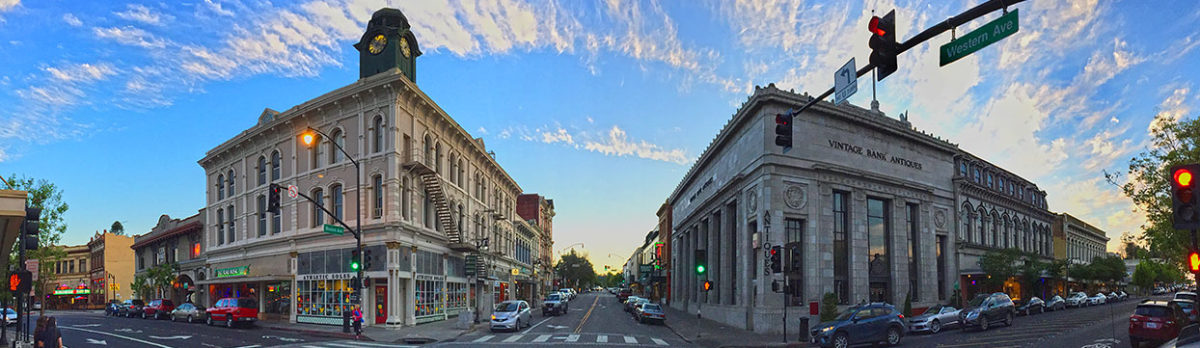
In the late sixties she backed the Core Area Plan, a federally funded redesign of the downtown that called for converting Kentucky Street between Western Avenue and Washington Street into a closed-off mall, and demolishing all the buildings along the east side of Petaluma Boulevard from D to Oak streets to install a six-lane thoroughfare along the river.[12]
Mayor Helen Putnam (center) displaying illustration of proposed Core Plan on the Washington Street Bridge, 1969 (photo Sonoma County Library)
Two months before the Core Area Plan was put before voters, Petaluma’s urban renewal bulldozer hit a speed bump. The Healey Mansion, a stately Queen Anne Victorian at the corner of Washington and Keokuk streets, utilized for half a century as a funeral parlor, was torn down for a new gas station. Its leveling became the rallying cry of a local historic preservation movement.[13]
In June, voters rejected the Core Plan bond issue while reelecting Putnam to a second mayoral term by a slim margin. Deftly, she pivoted her downtown stance afterward from destruction to restoration, and began chasing federal tax credits for adaptive reuse—retrofitting old buildings for new uses.[14]
The trend began in 1964 with the transformation of San Francisco’s Ghirardelli Chocolate Factory into a historically themed center of shops and eateries.[15]Two years later, Congress passed the National Historic Preservation Act, giving communities some means of protecting their historic fabrics from the slash-and-burn of urban renewal. Grants and tax credits followed.[16]
National Ice & Cold Storage Building, E. Washington & Lakeville streets, c. 1950. (photo Sonoma County Library)
Lakeville Shopping Center at E. Washington & Lakeville streets (photo public domain)
Petaluma’s first attempts at adaptive reuse began in 1972. Developer Kieckhefer set out to convert the National Ice and Cold Storage Building, built in 1908 at the corner of East Washington and Lakeville streets, into a local Ghirardelli Square. Once he saw the price tag for seismic upgrading, he changed his mind, and instead tore the building down to erect the Lakeville Shopping Center in its place.[17]
That same year, Victor and Marisa DeCarli recombined the two Gross Buildings, extending from Petaluma Boulevard to Kentucky Street, to create the Lan Mart Center of boutique shops.[18]Their initiative inspired Putnam to marshal a crusade to revive Petaluma’s historic downtown waterfront, using the old Golden Eagle Mill as her cornerstone.
Lan Mart Building, 35 Petlauma Blvd North, 1977 (photo Sonoma County Library)
What she needed was someone to lead the charge, not just a developer, but a charismatic ringmaster like Bert Kerrigan. Hired as a front man for the Chamber of Commerce in 1918, Kerrigan unleashed upon the town an energetic, three ring circus atmosphere that boosted Petaluma’s prosperity and fame as the “Egg Basket of the World.”
For help, Putnam reached out to an old friend, Bill Murray, chairman of the Bank of Marin, who had started his banking career in Petaluma during the 1950s. He had just the man for the job: Ralph “Skip” Sommer, a former stage actor and IBM salesman turned theme developer. Growing up in Michigan, Sommer spent his summers driving horse-drawn carriages of tourists around Mackinac Island, a Victorian-era resort that still bans automobiles. He understood history as an economic engine. [19]
Skip Sommer aboard horse and buggy, Mackinac Island, 1950 (photo courtesy of Skip Sommer)
Murray, whose bank had financed two of Sommer’s conversions of historic buildings into shops and restaurants in Marin, drove him up to Petaluma for his first visit.[20] Lured by federal tax credits and Murray’s financial backing, Sommer jumped at the opportunity. With Putnam’s assistance, the proposal was fast-tracked through the city planning commission, bypassing the need for an environment impact report.
Then came the deal killer: $275,000 for seismic upgrading ($1.4 million in today’s currency). Sommer blinked, until Murray told him the bank would finance it.[21]
Sommer staged the grand opening of the Great Petaluma Mill in October 1976 with the razzle dazzle of Harold Hill in “The Music Man.” Soon, he was piloting his yacht, The Great Eagle II, up the Petaluma River to proclaim the Turning Basin the new port of call for recreational boating. The press ate it up, dubbing him the “new business czar of the downtown waterfront area.”[22]
Great Petaluma Mill, 1980s (photo Sonoma County Library)
That same year, the U.S. Supreme Court let stand the ruling of a lower appeals court which had granted Petaluma the right to preserve the city’s character and open spaces “by growing at an orderly and deliberate pace.”[23]Putnam’s two pronged approach—sustainable growth paired with a revitalized downtown—had worked.
In the first year of the Great Petaluma Mill’s operation, downtown sales taxes increased by 30% thanks to increased foot traffic. A restoration fever soon overtook the downtown with developers of adaptive reuse flocking to town.[24]
Mapof shops and restaurants in the Great Petaluma Mill complex, 1979 (courtesy of Skip Sommer)
But Putnam wasn’t finished. She wanted to anchor the new recreational Turning Basin with the warmth of Victorian homes.
In 1976, the Wendy’s hamburger chain purchased the Burns-Farrell house at East Washington and Wilson streets with plans to demolish it for a burger joint. Putnam negotiated a deal to have Sommer buy the house for $1, and then move it to an empty lot on the Turning Basin, where he converted it into a restaurant called the Farrell House (today’s River House).[25]
Burns-Farrell House being moved from E. Washington Street to the Turning Basin, 1979 (photo courtesy of Skip Sommer)
Burns-Farrell House (today’s River House) on Turning Basin (photo Scott Hess)
The next year, she did the same with the Pometta House, a Victorian on Petaluma Boulevard South between C and D streets, slated for destruction for a new bank parking lot. Sommer moved it to 1 C Street, beside today’s Petaluma’s Yacht Club, converting it into an office building.[26]
Pometta House, Petaluma Blvd South, between C & D streets, 1977 (photo Sonoma County Library)
Pometta House in foreground at C & 1st streets on the Turning Basin, 2023 (photo courtesy of Scott Hess)
In 1979, Sommer sold the Great Petaluma Mill in order to help fund his next adaptive reuse performance out on the coast and his producer, Mayor Putnam, began her newly elected term as a Sonoma County supervisor. Petaluma would never be the same.[27]
Petaluma Turning Basin (photo courtesy of Scott Hess)
*******
A version of this story appeared in the Petaluma Argus-Courier, May 12, 2023.
FOOTNOTES:
[1] “He’s Not Your Typical Developer,” Petaluma Argus-Courier, August 28, 1975; Interview with Skip Sommer by John Sheehy, December 23, 2022, Sonoma County Library Archives.
[2] Interview with Skip Sommer by John Sheehy, December 23, 2022, Sonoma County Library Archives.
[3] “Unique Development Announced,” Petaluma Argus-Courier, May 12, 1975.
[4] “Unique Development Announced,” Petaluma Argus-Courier, May 12, 1975.
[5] “Design Plan Passes; Is Effective at Once,” Petaluma Argus-Courier, March 28, 1972; “Good Case for Housing Limit,” Petaluma Argus-Courier, April 26, 1973; “City Growth Ordinance Outlawed,” Petaluma Argus-Courier, April 29, 1974; Growth Suit Decision Not Expected for Some Time,” Petaluma Argus-Courier, February 15, 1975.
[6] “Helen Putnam, First Woman Ever to Seek Office of Mayor,” Petaluma Argus-Courier, May 25, 1965.
[7] “River May Be Making a Comeback,” Petaluma Argus-Courier, August 28, 1975.
[8] “Cotati Man is First Fatality on Freeway,” Petaluma Argus-Courier, November 17, 1856.
[9] “Golden Eagle Completes McNear Deal,” Petaluma Argus-Courier, June 17, 1958; “Mayor Discusses Golden Eagle’s Present Property,” Petaluma Argus-Courier, March 24, 1964 “Golden Eagle’s Century Old Mill Site,” Petaluma Argus-Courier, February 13, 1965.
[10] “Golden Eagle, Once Towering Over Petaluma, Like a Phoenix Reborn,” Petaluma Argus-Courier, April 26, 1975.
[11] “Rezoning Aids Expansion Central Business District,” Petaluma Argus-Courier, January 17, 1967; “Our Most Important Need,” Petaluma Argus-Courier, September 11, 1967.
[12] “More Parking Would Boost Downtown Area,” Petaluma Argus-Courier, August 3, 1968.
[13] “Money to Decide Mansion’s Fate,” Petaluma Argus-Courier, March 1, 1969; “Thanks for the Effort,” Petaluma Argus-Courier, May 13, 1969.
[14] “Putnam Wins, Bonds Lose,” Petaluma Argus-Courier, June 11, 1969.
[15] “Old, Familiar Glow,” San Francisco Examiner, November 30, 1964.
[16] Historic Preservation & Development, September 20, 2006, U.S. Department of the Interior.
[17] “Center Project Proceeds,” Petaluma Argus-Courier, December 14, 1972; “New Building to Follow Razing,” Petaluma Argus-Courier, February 17, 1973.
[18] “Lan Mart Stores are Commercial Experiment,” Petaluma Argus-Courier, February 15, 1973; “Lan Mart Center Has Grand Opening,” Petaluma Argus-Courier, September 6, 1973.
[19] Interview with Skip Sommer by John Sheehy, December 23, 2022, Sonoma County Library Archives; “He’s Not Your Typical Developer,” Petaluma Argus-Courier, August 28, 1975.
[20] “Skip Sommer’s Ideas Pay Off Very Well at Lark Creek Inn,” San Rafael Daily Independent, October 13, 1972; “Old Western Look,” San Rafael Daily Independent, October 30, 1974.
[21] “Great Petaluma Mill Needed Quake-proofing,” Santa Rosa Press Democrat, August 1, 1976; Interview with Skip Sommer by John Sheehy, December 23, 2022, Sonoma County Library Archives.
[22] “Reviving a Turn of the Century Town Center,” Santa Rosa Press Democrat, November 8, 1977; Bill Soberanes column, Petaluma Argus-Courier, November 25 1977.
[23] “Growth Review Denied,” Petaluma Argus-Courier, February 23, 1976.
[24] “Ambitious New Business Owners See Potential in Old Buildings,” Santa Rosa Press Democrat, November 8, 1977; “Mill Played a Key Role in Downtown Revitalization,” Petaluma Argus-Courier, January 9, 1980.
[25] “Historic Home to Become Restaurant at New Site,” Petaluma Argus-Courier, October 6, 1976.
[26] “House on Wheels,” Petaluma Argus-Courier, June 5, 1978.
[27] “Putnam Elected Supervisor,” Santa Rosa Press Democrat, November 8, 1978: “Marin Investors Buy Great Petaluma Mill,” Petaluma Argus-Courier, April 19, 1979.