
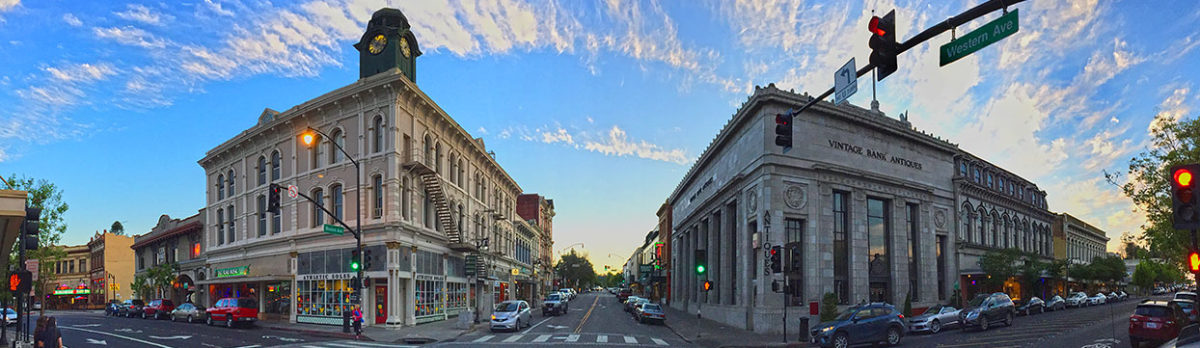

In 1862, Petaluma merchant John Sroufe and his partner James Daly built themselves a new grocery in a building currently occupied by the Thrifty Hippy Thrift Store at 218 Petaluma Boulevard North. After 14 years in the grocery trade in Petaluma, Sroufe went on to become one of the wealthiest whiskey merchants and mining investors in the American West.
Born in Kentucky and raised in Ohio, Sroufe crossed the plains to California via wagon train with his wife in 1850. The couple spent a few struggling years in El Dorado County, where their first daughter was born, before settling in Petaluma in 1856. [1]

The next year, Sroufe partnered with an Irishman named James Daly in opening the Daly & Sroufe Grocery on Petaluma’s Upper Main Street across from Hill Plaza Park, at what is today 226 Petaluma Boulevard North. In 1862, they built a new brick building next door—at what is today 218 Petaluma Boulevard North—and relocated their grocery there. [1a]

Sroufe became actively engaged in the Petaluma business and political communities, serving as a city trustee (city councilman) from 1863 to 1865.[2] He and his wife lived with their three daughters at 237 Keller Street (the Sroufe house was replaced in 1908 with the current house on the site by W.F Farrell).[3]
In 1865, Sroufe bought out Daly, changing the name of grocery to J. Sroufe & Co.[4] Two years later, he purchased an interest in a wholesale producer dealer with H.L. Dodge in San Francisco, which became Dodge & Sroufe. In 1870, he decided to move to San Francisco. Selling his grocery to Reinhardt & Hildburgh, he bought out his partner Dodger in the wholesale produce business, and, with a new partner named L.R. Sweeney, renamed the business Sroufe, Sweeney & Co. He also invested in extracting mercury from his Excelsior Quicksilver Mining Company north of Healdsburg.[5]

In 1875, Sroufe changed gears again. Selling his interest in the produce wholesale company, he partnered with an Irish entrepreneur named Hugh McCrum to purchase J.M. Goewey & Co., a liquor wholesaler on Front Street. Renamed Sroufe & McCrum, the company specialized in imported liquors and Kentucky whiskey. A colorful character who made a small fortune mining silver in the Comstock Lode, McCrum roamed the West as the company’s salesman, while Sroufe managed affairs at the home office.[6]

With their business flourishing, Sroufe & McCrum moved into larger quarters at 208-210 Market Street in 1880 .[7] They also started looking for new business opportunities.

In 1883, Adolph Sutro, the soon-to-be mayor of San Francisco, bought the Cliff House, a city icon perched upon rock above the Pacific Ocean. Built in 1863 as an exclusive resort for the wealthy, the Cliff House had fallen on hard times and was losing money. After investing in an extensive renovation, Sutro leased out the resort’s main attraction—its restaurant—to Sroufe and McCrum.[8]

To Sutro’s displeasure, they attracted a clientele of drinkers and gamblers, giving the Cliff House a scandalous reputation and resulting in him terminating their lease within two years. He instructing their successor, James M. Wilkins, to “clear out the riffraff,” and restore the restaurant to a family-friendly atmosphere.[9]
Wilkins operated the restaurant for the next 17 years, during which time the Cliff House burnt down in 1894 and was rebuilt by Sutro in a more elaborate rendition. During those years, Wilkins often turned to Sroufe for loans of liquor and cash to stay afloat. Finally, in 1903, Sroufe called in the debts which had grown to $38,000 ($1.4 million in today’s currency). As Wilkins was unable to pay, Sroufe was left holding the bag.[10]

In the mid-1880s, Sroufe and McCrum turned their attention to Arizona, which McCrum regularly visited while peddling liquor to saloons. Investing in ranches and commercial properties, they also became partners for two years in the Bird Cage Theater, a notorious saloon in Tombstone, Arizona.[11]

Known for rowdy behavior, the theater’s walls were riddled with gunshot holes. The 12 balcony boxes inside doubled as a bordello between performances. The basement meanwhile hosted one of the longest poker games in history. With a buy-in of a thousand dollars ($35,000 in today’s currency), the game was played continuously for eight years, 24 hours a day, 7 days a week. It drew such notables as George Hearst, Diamond Jim Brady, Adolphus Busch, Doc Holliday, Bat Masterson, and Wyatt Earp.[12]
A more lucrative side business for Sroufe and McCrum in Arizona was mining gold and silver.[13] Their most lucrative investment was in the Silver Belt mine, which by 1888 had produced $300,000 of silver ($10 million in today’s currency), with expectations of millions more to come.[14]
In 1892, McCrum, retired from the liquor wholesale business—which Sroufe renamed J. Sroufe & Co.—to devote himself to expanding the partners’ mining investments in Arizona. In 1893, they joined with L.C. Hughes, governor of the Arizona Territory, as investors in the lucrative Silver Cave mine.[15]

Over his years in San Francisco, Sroufe maintained strong ties in Petaluma, continuing to serve as a stockholder in the Petaluma’s First National Bank, and making regular trips to town to visit with old friends.[16]
He died of pneumonia in 1904 at the age of 77, leaving an estate worth $500,000 ($20 million in today’s currency).[17]
FOOTNOTES:
[1] “Death of James Daly,” Petaluma Courier, June 27, 1888.
[1a] Ad for “New Firm—Daly & Sroufe,” Sonoma County Journal, July 17, 1857; Ad for Daly & Sroufe at 102 Main Street, Sonoma County Journal, May 6, 1859; “Dissolution Notice, Sonoma County Journal, August 29, 1862; Our Mechanical Enterprises,” Sonoma County Journal, October 24, 1862.
[2] “City Officers of Petaluma,” Petaluma Courier, April 12, 1877.
[3] “The Death of Mrs. J. Merrill,” Petaluma Argus, October 31, 1925: Sroufe daughter cites the family home address as 237 Keller Street; Note: in 1908, the house at 237 Keller Street, presumably Sroufe’s, was owned by William F. Farrell, who sold it to Charles Offutt, who then moved it to an empty lot at 516 Kentucky Street, next door to the former Revere House, which he had moved the same year to 512-514 Kentucky Street. In its place at 237 Keller Street, Farrell hired Brainerd Jones to design the house that currently stands there. Meanwhile, the house Offutt moved to 516 Kentucky Street was apparently torn down for the Petaluma Grocery parking lot in 1941 (“Purchased Farrell House,” Petaluma Courier, July 21, 1908; Splendid Improvement on Kentucky Street,” Petaluma Argus, March 17, 1916; “Bought Fine New Home,” Petaluma Argus, September 21, 1920; “House Warming at the Kynoch Home,” Petaluma Argus, November 10, 1920).
[4] “Grocery Store,” Petaluma Argus, January 19, 1865; “Our County Fair,” Petaluma Argus, October 7, 1868: first ad under J. Sroufe & Co.
[5] “Attention, Dairymen,” Petaluma Argus, November 28, 1867; Dissolution of Partnership,” Petaluma Argus, April 15, 1869; Ad for Reinhardt & Hildburgh, Petaluma Argus, May, 1870: they bought Sroufe’s grocery; Ad for Dodge & Sroufe, Petaluma Argus, July 2, 1870; Ad for Sroufe, Sweeney & Co., Petaluma Argus, November 26, 1870; “A Trip to the Mines,” Petaluma Argus, February 26, 1875.
[6] “New Firm,” Petaluma Argus, May 21, 1875; Ad for Sroufe & McCrum,” Petaluma Argus, August 27, 1875; Ad for Sroufe & McCrum, San Francisco Chronicle, February 5, 1880; “Chaparral Quartz,” San Francisco Chronicle, September 9, 1893; Hugh McCrum, the West’s Peripatetic Whiskey ‘Capitalist,’” Those Pre-Pro Whiskey Men!, pre-prowhiskeymen.blogspot.com.
“Hugh McCrum, the West’s Peripatetic Whiskey ‘Capitalist,’” Those Pre-Pro Whiskey Men!, pre-prowhiskeymen.blogspot.com.
[7] Ad for Sroufe & McCrum, San Francisco Chronicle, February 5, 1880.
[8] “Hugh McCrum, the West’s Peripatetic Whiskey ‘Capitalist,’” Those Pre-Pro Whiskey Men!, pre-prowhiskeymen.blogspot.com.
[9] “The Long & Peculiar History of the Cliff House in San Francisco,” TheVintageNews.com, https://www.thevintagenews.com/2016/12/29/the-long-peculiar-history-of-the-cliff-house-in-san-francisco;
[10] “Attaches the Cliff House,” San Francisco Chronicle, November 20, 1903; “Cliff House Will Go to Receiver Today,” San Francisco Examiner, November 20, 1903; “Wilkins Reopened Cliff House Yesterday,” San Francisco Chronicle, November 22, 1903.
[11] Michael Paul Mihaljevich, The Bird Cage Theater: The Curtain Rises on Tombstone, Arizona’s National Treasure (University of North Texas Press, 2024).
[12] “History of the Bird Cage Theater,” tombstonebirdcage.com.
[13] “Chaparral Quartz,” San Francisco Chronicle, September 9, 1893.
[14] “Personals,” Viriginia City Daily Territorial Enterprise, November 1, 1883; “Arizona: Prosperous Condition of the Silver Belt Mine,” San Francisco Chronicle, May 31, 1888;
[15] Legal Notice, San Francisco Examiner, January 4, 1892; “Chaparral Quartz,” San Francisco Chronicle, September 9, 1893; “$32,000: The Amount of Another Bond on a valuable Mining Property at Dos Cabezas,” Tombstone Epitaph, October 11, 1893.
[16] Ad for First National Gold Bank, Petaluma Argus, October 1, 1875; Sroufe visits cited in the Petaluma Courier: September 9, 1885; August 29, 1888; September 4, 1889; June 17, 1891; April 20, 1895; March 16, 1898; December 24, 1900; Sroufe visits cited in the Petaluma Argus: May 1, 1886; September 3, 1887.
[17] “Was Petaluma’s First Merchant,” Petaluma Courier, July 18, 1904; “Leaves Entire Estate Unconditionally to His Wife,” San Francisco Call, July 20, 1904.