Entrance to the Union Hotel Beer Hall, Main and B streets, c. 1892, with the saloon proprietor John Hermer most likely the man with the white beard (Sonoma County Library)
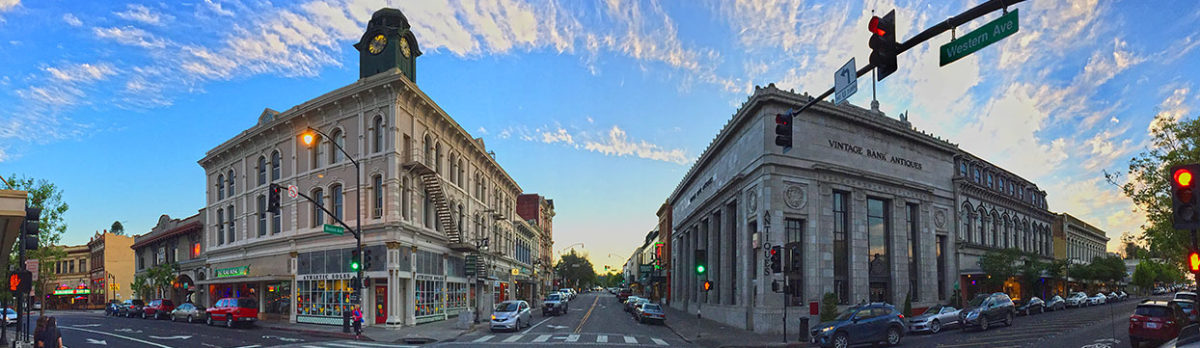
In 1852, two brothers from Germany, Herman and John Schierhold, purchased a lot at the southwest corner of Main Street and today’s Western Avenue. Using timber they hauled down from Freestone, they built a two-story hotel. A classic German “gasthaus,” it included a bar and billiards room on the bottom floor, with six rooms upstairs for boarders and guests upstairs.[1]
The Schierholds’ gasthaus became an anchor for Petaluma’s growing German merchant district. By the mid-1870s German-owned businesses extended along the west side of lower Main Street from Western Avenue to Center Park (today’s Historic Chinatown Park).
They included Heinrich Matthies’ Continental Hotel and John Pfau’s Centennial Building (today’s Land Mart), which featured a German saloon, a livery stable, Heinrich Dortmund’s Wine Depot, and the German Druids Hall.
German-owned Continental Hotel and beside it the Centennial Building, 1890s (courtesy of Dan Brown Collection)
Two blocks away on Fourth Street between B and C streets sat Turn Verein, or Turner Hall, which served as a German social club, hosting lectures, social events, dances, festivals, and musical performances.[1a]
Turn Verein or Turner Hall at Fourth Street between B and C streets, built 1875 (Petaluma Historical Library & Museum and Petaluma Courier)
In 1855, the Schierholds sold their gasthaus to a woman named Rosanna Loftus who renamed it the Farmers’ Hotel. A married woman, Loftus purchased the hotel as a “sole trader,” which meant she was legally able to own and operate her own business independent of her husband.[2]
1855 map with arrow pointing to site of Farmers Hotel (Sonoma County Library)
Herman Schierhold went on to operate the Relief Saloon and the Capitol Saloon in town, as well as the Petaluma Brewery. The first brewery in Sonoma County, it was originally founded in 1855 by a fellow German immigrant, Fredrick Christlich.[3]
In 1858, a German named August Starke purchased the Farmers’ Hotel from Loftus, renaming it the Union Hotel & Saloon.[4] In 1866, he leased out operation of the hotel and saloon to Heinrich Matthies, who added “Deutsche Gasthaus” to the name Union Hotel.[5]
Illustration of the Union Hotel, Deutsche Gasthaus, 1885 (Map of Petaluma by William W. Elliott, Sonoma County Library)
In 1876, Petaluma’s leading capitalist John McNear purchased the hotel building and property from Starke’s widow, Frances.[6]
In 1881, McNear sold the Union Hotel building to fellow capitalist Isaac Wickersham, who moved it to property he owned at the southeastern corner of Main and B streets. That cleared the way for construction of the Masonic Lodge at the hotel’s original site on the corner of Main and Western Avenue.
Masonic Lodge at Main Street and Western Avenue, 1902 (Petlauma Historical Library & Museum)
Meanwhile, Wickersham undertook a complete rebuilding of the hotel in its new location, adding 17 new rooms.[7]
In 1889, the description “Deutsche Gasthaus” was dropped from ads for the Union Hotel by longtime operator Samuel Carstens, a Danish immigrant A German named John Hermer ran the Union Beer Hall in the hotel.[8]
Ad for Union Hotel Beer Hall, Petlauma Courier, May 24, 1892.
In 1900, a fire, suspected to be arson, badly damaged the hotel, destroying its bar and bowling alley. By that time, the hotel was owned by G.P. McNear, who leased it to Claus Struve, a German immigrant, and Jimmie Rasmussen, a Danish immigrant.[9]The hotel was restored and reopened.
In 1902, G.P. McNear’s Oriental Mills & Feed headquarters on Main Street across from Penry Park (then Hill Plaza) burned down. McNear decided to relocate his operation to the site of the Union Hotel, which sat in front of one of his grain mills (today’s Great Petaluma Mill).
He announced plans to move the Union Hotel to Third streets and C streets so that he could clear the site for his new building. A few months later, he changed his mind, and decided to tear the hotel down instead.[10]
New G.P. McNear Feed Company Building, 1903 (Petaluma Historical Library & Museum)
So ended the legacy of a 50-year old Petaluma landmark building.
FOOTNOTES:
[1] “Local News As Condensed,” Petaluma Argus, October 3, 1902; “Built the Union Hotel,” Petaluma Courier, October 3, 1902; Note: no mention of the name of the Schierholds’ hotel found.
[1a] “Cosmopolitan Hotel,” Petaluma Argus, August 25, 1876; “Pfau’s Centennial Building,” Petaluma Argus, March 3, 1876; “Centennial Headquarters,” Petaluma Argus, July 14, 1876; “The Druids,” Petaluma Courier, December 22, 1880; “Turners’ Ball,” Petaluma Argus, January 1, 1875.
[2] Legal Sole Trader Notice, Petaluma Journal, September 22, 1855; Ad for Farmer’s Hotel, Petaluma Journal, November 20, 1855; Note: not clear if Schierholds were the owners at time of sale to Loftus.
[3] “Courierlets,” Petaluma Courier, October 22, 1884; “H. Schierhold Died Weeks Ago,” Petaluma Argus, December 22, 1905; “Petaluma Breweries,” Petaluma Argus, December 8, 1876; Note: Christlich launched the brewery with a partner named Erbe, who by 1860 had sold out his interest to Christian Theilman, who died in 1864.
[4] Ad, Sonoma County Journal, February 12, 1858: Starke converts Farmer’s Hotel to Lager Beer Saloon; “Brutal,” Sonoma County Journal, February 11, 1859: Starke’s establishment now referred to as the “Union Billiard Saloon”; Ad for Union Hotel, Sonoma County Journal, October 12, 1860.
[5] Ad for Union Hotel, Petaluma Argus, September 6, 1866. Note: by the 1870s, Matthies was also operating the Continental Hotel (“Cosmopolitan Hotel,” Petaluma Argus, August 25, 1876).
[6] “Brevities,” Petaluma Argus, October 20, 1876; “Real Estate Transactions,” Petaluma Argus, November 3, 1876.
[7] “City Improvements,” Petaluma Courier, June 1, 1881; “Housewarming,” Petaluma Argus, August 19, 1881; “Reopened,” Petaluma Courier, August 31, 1881; Ad for Union Hotel, Petaluma Argus, September 30, 1881.
[8] Last ad for Union Hotel including “Deutsche Gasthaus,” Petaluma Courier, January 30, 1889; Ad for Union Beer Hall, Petaluma Courier, May 24, 1892; “John Hirmer Dead,” Petaluma Courier, May 31, 1894.
[9] “The Union Hotel Badly Wrecked,” Petaluma Argus, July 9, 1900.
[10] “A Midnight Blaze,” Petaluma Courier, June 11, 1902; “Union Hotel to Be Moved to Third and C Streets,” Petaluma Argus, August 15, 1902; “Local News As Condensed,” Petaluma Argus, October 3, 1902.
Women restaurant operators, Sonoma County, 1880s (photo Sonoma County Library)
As a founding merchant of Kent & Smith, Petaluma’s first general store, Cassie Miranda Kent was said to have few equals.[1]You wouldn’t know it from the history books. In their pages, Petaluma was created by men—rugged pioneers who, after venturing west for gold, stayed to build the river town. That is, until their luck ran out and the debt collectors came calling.
In such instances, men fortunate enough to be married triggered a fail-safe option: California’s Sole Trader Act. Passed by the state legislature in 1852, the act enabled a married woman to independently own and operate her own business. Its intention was to provide women burdened with dissolute or absent husbands a means of supporting themselves.[2]Husbands however had a different view, using the act as a legal equivalent of hiding behind a woman’s skirt.
That was keeping in step with the spirit of the Gold Rush, best described by railroad magnate Collis P. Huntington as “whatever is not nailed down is mine, and whatever I can pry loose is not nailed down.”[3]
Petaluma was founded on the same ethos. In 1852, a failed gold miner named George H. Keller made an illegal squatter’s claim to 158 acres of a Mexican land grant. He then mapped out the town of Petaluma and began selling fraudulent lots to fellow disappointed miners looking to stake a claim in the next gold rush—land speculation.[4]
Illustrated map of Petaluma with Kent & Smith General Store and adjacent warehouse highlighted in red, 1855 (Sonoma County Library)
Cassie Kent—one of only three women in town at the time—and her husband Walter were among the first to buy in. With a partner named H.H. Smith, they purchased a lot from Keller on Main Street, where they built the town’s first general store, Kent & Smith, across from today’s Putnam Plaza. [5]Walter also served as the town’s second postmaster after the first, Keller’s 21-year old son Garrett, fled town with his father and the money he made in real estate.[6]
Kent & Smith opened its doors just as Petaluma was evolving from a village of meat hunters supplying wild game to San Francisco, into a bustling shipping port for potatoes, Sonoma County’s first boom crop. Within a couple years, overproduction and soil exhaustion led to a potato bust, after which Petaluma’s economy experienced a brief downturn during the national 1854 recession, before rebounding with the California wheat boom in the late 1850s. In the midst of that lull, Kent & Smith went belly up, and was sold at public auction to pay off creditors.[7]
The Kents also owned a 160-acre farm south of town. To shield it from the money hounds, 26-year-old Cassie filed as a sole trader, claiming she alone was in charge of raising stock and poultry on the farm.[8]
Sole trader legal notice posted by Cassie Kent (Sonoma County Journal, December 8, 1855)
The Kents weren’t alone in exploiting the act to evade debt collectors. More than three dozen married women filed as sole traders in Petaluma between 1852 and 1862. The majority registered their business as operating farms and raising livestock. Others listed wheelwright, saloon keeper, liquor seller, hotel keeper, store merchant, and lumber dealer.[9]In many cases, they designated their husbands as working agents, at least on paper.[10]
Not all sole trader filings were fraudulent. The state constitution allowed married women to personally retain assets they brought to a marriage, providing some with capital to invest. As Petaluma’s female population grew, comprising 38% of the town’s 1,338 residents by 1857, three married women—Mary Ann Trevor, Susan Cowles, and Hannah Davis—filed as sole traders to open their own millinery and dress shops.[11]Mrs. Fanny Ver Mehr filed to create a boarding school for girls.[12]
19th century woman-owned millinery shop (photo public domain)
Then there was Cassie Kent.
In the “separate spheres” of the Victorian era, women were relegated to the home while men engaged in the public world of business and politics. However, in California’s boom and bust cycles, many women unable to rely upon a breadwinning man were forced to work outside the home. Working class women were largely limited to domestic occupations—cooking, baking, house cleaning, washing clothes—or else working on the factory floors of Petaluma’s woolen and silk mills.[13]Among the middle-class, some women pursued careers as school teachers while others partnered silently in merchant enterprises with their husbands.[14]
A handful of women, however, challenged the notion that characteristics necessary to succeed in small business— ambition, assertiveness, and competition—were quintessentially masculine traits. Among them was Cassie Kent.
In 1857, she went into business on her own, leasing the Central Hotel on the southwest corner of Kentucky Street and Western Avenue, a site occupied today by the Chase Bank.[15]
Ad for Cassie Kent’s Central Hotel, 1857 (Sonoma County Journal, June 5, 1857)
It wasn’t the first hotel in Petaluma operated by a woman. That honor belonged to Rosanna Loftus, who in 1853 opened the Farmers Hotel (later renamed the Union Hotel) at the corner of Main Street and Western Avenue, where the Masonic Lodge stands today.[16]
Cassie’s Central Hotel was originally constructed in Valparaiso, Chile, and shipped to California in 1851 by a speculator named Charles H. Veeder. Veeder initially erected it in the newly established town of Vallejo, slated at the time to become the state capital. In 1853, state legislators, disenchanted with Vallejo’s sluggish development, voted to move the capital to Benicia, leaving Veeder $18,000 in debt ($700,000 in today’s currency).[17]
Veeder promptly dismantled the hotel and shipped it to Petaluma, reopening it as the Central Hotel, just before the potato boom went bust. Forced to declare bankruptcy, he leased the hotel to Cassie before moving on to his next gamble, developing the town of Calpella in Mendocino County.[18]
Hospitality proved a volatile industry in the new town. Cassie operated the Central Hotel for less than a year before turning it over to two other women, Mrs. Finchley and Mrs. Goodrich, who renamed it the Clinton House. A year later, two brothers named Schreck assumed the lease, changing the name to the City Hotel. The hotel was later rebuilt and renamed the Continental Hotel before being consumed by fire in 1968.[19]
The City Hotel, c. 1875, after extensions in 1868 and 1875 (photo Sonoma County Library)
In 1862, debt collectors convinced state legislators to close the loopholes in the Sole Trader Act. Going forward, women filing fraudulent claims were charged with felonies and husbands were prohibited from acting as working agents. But fraud wasn’t the only thing legislators were looking to clamp down on.[20]
Under the revised act a woman was required to testify before a judge as to why she desired to operate a business independent of her husband.[21] Women protested the change, arguing it forced a woman to air her dirty laundry in public by disclosing as much against her husband as she would in securing a divorce from him, and then explaining to a judge why she wasn’t simply divorcing him.[22]
Up through the 1890s, the majority of women-owned businesses in Petaluma were millineries and dress shops—an 1877 directory listed 12 in town—along with a few restaurants, boarding houses, and hair salons.[23]
Ad for bonnets in Petersen’s Magazine, 1880s (illustration courtesy of Princeton University)
By the turn of the century, progressivism, feminism, and immigration were opening the door to more women operating hotels, bakeries, restaurants, houseware stores, art supply shops, music schools, medical practices, newspapers, brothels, ice cream stands, and horse-drawn hacks, or taxi, services.[24]Among those who were married, some utilized the Sole Trader Act, while most did not.[25]
Fannie Brown’s brothel at 1st and C streets, early 1900s (photo Petaluma Historical Library & Museum)
In 1905, 24-year-old Miss Frances Hardy opened the Bon Ton Millinery Shop in the Towne Building, which in 1867 replaced the building Walter and Cassie Kent constructed for their general store in 1852.[26]
Bon Ton Millinery in the Towne Building, Main Street, 1931 (photo Sonoma County Library)
Hardy operated Bon Ton at that location for fifty years, until the Petaluma City Council condemned the building in 1956 and converted the site into a parking lot, which it remains today, directly across from Putnam Plaza.[27]
Parking lot that replaced the Towne Building on Petaluma Boulevard North in 1956 (photo John Sheehy)
As for Cassie Kent, she eventually divorced Walter, opened her own sewing business and remarried, settling with her second husband in a cozy cottage on Post Street, where she died in 1902 at the age of 72.[28]
******
A version of this story appeared in the Petaluma Argus-Courier, August 25, 2023.
FOOTNOTES:
[1] “Entered into Eternal Rest,” Petaluma Courier, July 5, 1902.
[2] “The Sole Trader Act,” Sonoma County Journal, January 16, 1857; Bonnie L. Ford, “Women, Marriage, and Divorce in California, 1849–1872,” California Legal History, Vol. 16, 2021, p. 34.
[4] John Sheehy, “The Story of the True Founder of Petaluma,” Petaluma Argus-Courier, February 11, 2021.
[5] David Wharff wrote in a letter to A.B. Behrens, April 26, 1918, that there were only three women in Petaluma— Mrs. Horton, Mrs. Kent, and Mrs. Douglass—when he arrived in the fall of 1852, Sonoma County Library; Robert A. Thompson, Historical and Descriptive Sketch of Sonoma County, California (L.H. Everts, 1877), p. 55; “Worked on Original Building,” Petaluma Courier, April 15, 1902; “Fire Bell,” Sonoma County Journal, December 25, 1857; “Real Estate Petaluma,” Sonoma County Journal, January 28, 1859; “Death of Major Hewlett,” Petaluma Courier, January 8, 1896; Munro-Fraser, History of Sonoma County (Allen, Bowen & Co, 1880), pp. 260-261.
[6] A Register of Officers and Agents, Civil, Military, and Naval in the Service of the United States, 1853, United States, Department of State.
[7]“Fire Bell,” Sonoma County Journal, December 25, 1857; “Real Estate Petaluma,” Sonoma County Journal, January 28, 1859; “Death of Major Hewlett,” Petaluma Courier, January 8, 1896; “Worked on Original Building,” Petaluma Courier, April 15, 1902; Munro-Fraser, History of Sonoma County (Allen, Bowen & Co, 1880), pp. 260-261; Victor Zarnowitz, Business Cycles: Theory, History, Indicators, and Forecasting (Chicago: University of Chicago Press, 1996), p. 221-226.
[9] Sole Trader Notices, Sonoma County Journal: December 8, December 22, December 29, 1855; June 7, June 21, August 22, August 29, October 10, October 31, December 5, 1856; January 15, May 8, October 23, 1857; April 15, May 28, June 18, July 28, November 30, December 10, 1858; March 18, April29, September 16, September 20, December 2, 1859; January 20, December 21, 1860; January 4, February 15, April 19, July 9, August 23, November 30, 1861; January 4, February 14, March 7, March 14, April 11, 1862.
[10] “The Sole Trader Act,” Sonoma County Journal, January 16, 1857.
[11] Robert A. Thompson, Historical and Descriptive Sketch of Sonoma County, California (University of Wisconsin, 1877) p. 56; Ad, Petaluma Journal, August 22, 1856; Ad, Sonoma County Journal, October 23, 1857; Ad, Sonoma County Journal, April 15, 1859.
[13] Bonnie L. Ford, “Women, Marriage, and Divorce in California, 1849–1872,” California Legal History, Vol. 16, 2021, pp. 33-34; Sixty girls working at Carlson-Currier Silk Mills, “Odds and Ends,” Petaluma Courier, January 22, 1893; Women comprise a third of 36 mill workers, soon to increase to 100, “Petaluma Woolen Mill,” Petaluma Courier, November 18, 1891.
[16] Ad, Petaluma Journal, November 20, 1855; Munro-Fraser, History of Sonoma County, California (San Francisco, CA: Alley, Bowen & Co., 1880), p. 263: The Union Hotel, listed as having opened in 1853, was most likely was the Farmers Hotel in 1853–August Starke assumed ownership of the Farmers Hotel in 1858, initially renaming it the Petaluma Lager Beer Saloon, and then in 1859 the Union Hotel (Ads, Sonoma County Journal: February 12, 1858; February 11, 1859; October 12, 1860; October 22, 1861).
[17] Munro-Fraser, History of Solano County…and Histories of Its Cities, Towns, etc. (Wood, Alley & Co), 1879, p. 193; Adair Heig, History of Petaluma (Scottwall Publishing, 1982), p.30; “Personal,” Petaluma Journal, March 15, 1856.
[18] Munro-Fraser, History of Sonoma County, California (San Francisco, CA: Alley, Bowen & Co., 1880), p. 263; Ad, Sonoma County Journal, June 12, 1857; “The Legislature,” Nevada Journal, January 24, 1852; “Assignee’s Sale in Bankruptcy,” Alta California, January 18, 1856; “Petaluma,” Sacramento Bee, December 15, 1857; “Letter from Col. Veeder, Calpella,” Sonoma Democrat, August 26, 1858; “Items of Local Interest,” Petaluma Argus, September 24, 1875.
[19] Ad, Sonoma County Journal, November 27, 1857; Ad, Sonoma County Journal, January 28, 1859; “Hotel Will Be Called The Continental,” Petaluma Argus, June 9, 1905; “Fire Destroys Hotel,” Petaluma Argus-Courier, May 6, 1968.
[20] “Sole Traders,” Sacramento Bee, October 6, 1862.
[21] “The Collection of Debts,” Sonoma County Journal, March 14, 1862; “Women Sole Traders,” Marysville Daily Appeal, March 23, 1862; “Sole Traders,” Sonoma County Journal, July 25, 1862; Ford, pp. 26-27.
[22] “Woman in California,” Petaluma Courier, December 21, 1893.
[23] Business types determined by a review of business ads and listings in the Petaluma Argus and Petaluma Courier newspapers 1855 to 1900 indicate 85 millineries and dress shops during that period ; 12 millineries and dressmaking shops were listed in “Our Industries,” Petaluma Argus, August 10, 1877; Ad for Mrs. E. Bradbury’s Tremont Bakery & Restaurant, Petaluma Argus, April 30, 1870; Ad for Madame Carter French hairdresser, Petaluma Argus, July 20, 1877; Ad for Mrs. Wilsey & Mrs. Avlesworth’s restaurant “Courierlets,” Petaluma Courier, October 24, 1888; Ad for Mrs. Lambert’s boarding house, PetalumaCourier, February 18, 1882; Alice Kessler-Harris, Out to Work: A History of Wage-Earning Women in the United States (New York, 1982).
[24] “Women Entrepreneurs: History of Women in Business,” Home Business, September 18, 2017; J.H. Starke and Mrs. G.W. Badger, furniture and housewares store, 19 Main, Ad, Petaluma Argus, June 4, 1884; “Mrs. Sarah Baruh operates a hack business (horse drawn taxi), “Hack Business,” Petaluma Argus, May 24, 1884; Mrs. Baruh also operates Baruh’s Store adjoining the American Hotel, Ad for J. Snow, Petaluma Argus, December 31, 1880; Mrs. Rowlston’s ice cream stand, “Courierlets,” Petaluma Courier, July 24, 1889; Ad for Dr. Ruth A. French, Case Block, corner of Kentucky Street and Western Avenue, Petaluma Courier, December 31, 1890; Ad for Christine E. Remarque, physician and surgeon, Petaluma Courier, August 15, 1894; Ad for Mrs. L. Lewis, proprietor of the Petaluma Hotel, Petaluma Courier, December 4, 1894; Ad for Mrs. F. White, proprietor of the Western Hotel, Petaluma Courier, December 22, 1894; Rena Shattuck’s launch of the Petalumian newspaper, “Petaluma’s New Paper,” San Francisco Call, June 7, 1895; Ad, Ad for Dr. Ruth P. Huffmann, physician, Petaluma Courier, November 2, 1896; Ads for Mrs. Cronk’s signs and art materials, Miss Maud S. Brainerd, teacher of piano and voice culture, and Miss L. Tourny, voice development and dramatic, Petaluma Courier, February 22, 1897; Madams Frankie Duval and Georgie Herbert applied for liquor licenses at their female boarding houses, which Sanborn maps used to designate brothels, “Board of Trustees,” Petaluma Courier, October 4, 1897.
[25] A search of legal notices for sole trader applications in the Petaluma Courier and Petaluma Argus newspapers identified only 15 sole trader applications made between 1862 and 1900.
[26] “Bon Ton Millinery Store is Opened,” Petaluma Argus, June 10, 1905; The site of the Kent & Smith general store was located most likely at 122-130 Petaluma Boulevard North, which is today a parking lot. John Lockwood described the town’s first 4th of July celebration in 1852 as being held in the Kent & Smith warehouse (“The Late J. E. Lockwood,” Petaluma Argus, December 13, 1904). That warehouse was replaced in 1856 by Capt. Palmer Hewlett with what is known today as the Steiger Building, and was initially occupied in the 1850s by Elder & Hinman Dry Goods Store. The building that originally housed Kent & Smith is cited in 1858 as still standing beside it to the south in ads, among them for the physician T.A. Hylton, “with office in old Kent & Smith Building one door below Messrs. Elder & Hinman” (Sonoma County Journal, March 26, 1858). S.D. Towne apparently replaced the Kent & Smith building with the Towne Building in 1867 (First ad mentioning the new Towne Building appears in the Petaluma Argus on September 5, 1867, for Frank Miller’s Crystal Baths and Shaving and Hair Dressing.
[27] “Memorial Won’t Go on May Ballot,” Petaluma Argus-Courier, May 20, 1956; Ad for Bon Ton, Petaluma Argus-Courier, May 11, 1956; Frances Hardy became Frances Studdert after marrying local merchant John W. Studdert in 1926, “The Studdert-Hardy Wedding,” Petaluma Argus-Courier, September 28, 1926.
[28] Ad, Petaluma Argus, November 16, 1877; “Divorce,” Petaluma Argus, December 12, 1879; “Married,” Petaluma Courier, July 8, 1885; “Entered Eternal Rest,” Petaluma Courier, July 5, 1902