John is a history detective who digs beneath the legends, folklore, and myths to learn what’s either been hidden from the common narrative or else lost to time, in hopes of enlarging the collective understanding of our culture and communities.
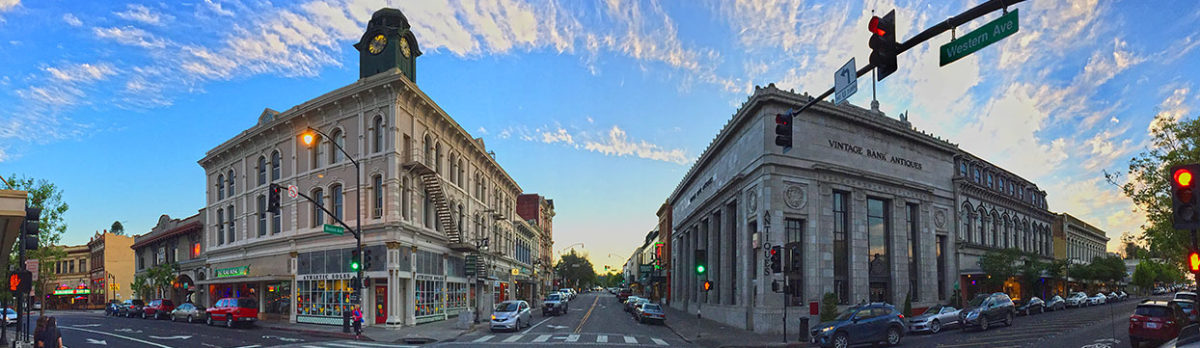
Hermann Sons Hall, 860 Western Street, erected 1931 (Photo courtesy of John Chu)
By John Sheehy & Jack Withington
In June of 1938, with local newspapers reporting that Jews were being persecuted by fascists in Europe, news came that Petaluma’s Hermann Sons Hall on Western Avenue had been rented out to the German American Bund, a pro-Nazi group, who planned to feature a political appearance by their West Coast leader, Hermann Schwinn of Los Angeles.
Jerome Koch, a 27-year old Petaluma educator and member of a progressive group called California Federation for Political Unity, wrote an open letter in the Petaluma Argus-Courier to the Hermann Sons Lodge, denouncing the Bund as a front for terrorism, espionage, and propaganda in Hitler’s attempt to undermine American democracy. Koch demanded that the lodge cancel the event.
The letter set off a wave of protest in town, from both individuals and groups such as the American Legion, Veterans of Foreign Wars, the AFL and CIO labor unions, the Communist Party (then a legal political party), and various Jewish organizations. In response, John Olmsted, owner and editor of the Petaluma Argus-Courier, accused Koch in an editorial of attempting to suppress free speech.
Koch responded that while he was an advocate of free speech and a free press, when it came to a Nazi organization like the Bund, he felt it Olmsted’s duty as a journalist to expose that their appeals to prejudice and ignorance were intended to instill violence and civil chaos as a means of ultimately undermining the very civil liberties Americans treasured.
Jerome Koch’s protest had a familial aspect—his father, Valentine Koch, an immigrant from Odessa who had fought for the U.S. in World War I and was foreman of the Petaluma Poultry Producers Cooperative in town, served as financial secretary of the local Hermann Sons Lodge. The elder Koch was left to publicly defend the lodge’s decision to rent out the hall, telling the Argus-Courier the Bund had requested it “supposedly for the presentation of a motion picture program.”
Members of the German American Bund marching near Camp Siegfried in New York, 1937 (Rex Hardy Jr./The LIFE Picture Collection, Getty Images)
Lodge members quickly held an emergency meeting to discuss the Bund’s hall rental. Part of the national fraternal Order of Hermann Sons, the Petaluma lodge had been established in 1901, following a large influx of German immigrants to the area, particularly from the Isle of Fohr region in the North Sea. Dedicated to preserving German culture, traditions, and language, the order took its name from Arminius-Hermann, a German chieftain who united the German tribes against the Romans in the ninth century, ending the Roman domination of Germany.
The Petaluma lodge members decided to let the event proceed on the grounds that the rental agreement was already made. Since the lodge did not allow either religion or politics to enter into their discussions, to cancel it on political grounds would violate their political neutrality.
Their response was somewhat disingenuous, as their members were familiar with the leader of the local Bund, Fritz Kuehn, who had staged similar pro-Nazi events at the hall over the preceding three years. Just months before, Kuehn had held a rally at the Germania Hall in Santa Rosa which was advertised as a “concert and artists’ evening,” but actually featured Schwinn and his attendants dressed in full military uniform with a large swastika flag draped over the stage.
Bund leader Hermann Schwinn, speaking at Washington’s Birthday celebration in Los Angeles
Schwinn had also appeared four weeks earlier at a Bund event in San Francisco, which generated headlines in the Argus-Courier for having attracted 2,000 anti-Nazi protestors. Finally, it was no secret to the members of the lodge that Kuehn’s Petaluma Bund chapter was one of the organization’s most active chapters on the West Coast.
Thirty-seven year old Fred “Fritz” Kuehn was controversial for other reasons as well. Having immigrated to America from Germany in 1921, he was drawn to Petaluma because his older sister Greta had settled in Cotati a decade before after marrying Otto Diestel, a chicken and dairy rancher. Kuehn set up a horsemeat slaughterhouse on a ranch he leased on Lakeville Highway, with an onsite hammer mill for crushing horse bones into bone meal for chicken feed. His operation regularly ran afoul with the Society for the Prevention of Cruelty to Animals (SPCA). An athlete, Kuehn also boxed as a welterweight for the Petaluma Spartan team, and served as team captain for a local polo team.
In the mid-thirties, Kuehn sold his slaughterhouse to Morris Cader, head of the B’nai B’rith Jewish Center and owner of Cader Brothers Hide Company, and moved into town, where he launched a new business, the Independent Ice and Supply Company. He also partnered in a new slaughterhouse plant, the Petaluma Poultry and Dog Food Company, on Lakeville Highway, which soon came under investigation by the SPCA.
In 1935, Kuehn became leader of the local chapter of Friends of New Germany, an American organization of ethnic Germans formed in 1933 to extol “German virtues” and promote the goals of Adolph Hitler’s Nazi party, in particular its anti-Semitism. Guided by Germany’s deputy fuhrer Rudolph Hess, members of the group were required to take an oath of loyalty to Hitler and swear they were of pure Aryan blood with no Jewish ancestry. They were also instructed to become American citizens, which Kuehn did in 1935, to demonstrate they weren’t foreign operatives.
That same year, Kuehn hosted a Christmas dinner for the Friends of New Germany at Penngrove’s Green Mill Inn, featuring a Christmas tree and a large block of ice carved in the shape of a swastika. He also staged events for the group at Hermann Sons Hall, including a birthday celebration for George Washington, whom the Nazis considered America’s “first Fascist,” maintaining that he was not a true believer in democracy. Promoted as musical performances with dancing, the events also featured lectures on Nazi developments in Germany and German propaganda films.
In 1936, the national Friends of New Germany organization dissolved in a flurry of infighting. It was replaced by a new pro-Nazi group, the German American Bund, launched by a man named Fritz Kuhn (no relation to Petaluma’s Fritz Kuehn). Aligned with the Silver Shirts, a white-supremacist, anti-Semitic group of 15,000 clustered primarily in the American South, the Bund was a paramilitary organization that dressed in the fashion of Hitler’s stormtroopers, with uniforms of black pants, gray shirts, blue overseas caps, and a black military-style Sam Browne belt.
Of the twelve million citizens of German blood in the United States at the time, the Bund could only claim 25,000 members, but they professed to have a much larger “whisper campaign” of financial donors. To indoctrinate new members, they quickly established twenty youth and training camps, as well as sixty-nine local chapters across the country. Frtiz Kuehn became leader of the Petaluma chapter.
Friends of New Germany Meeting, Los Angeles, 1935
Oral histories collected by Kenneth Kann for his book Comrades and Chicken Ranchers, which chronicles Petaluma’s robust community of Jewish chicken ranchers, many of them socialists who came to America escaping the pogroms in Russia and Eastern Europe, offer testimonies of Kuehn’s local Bund chapter parading down Western Avenue from Hermann Sons Hall to the B’nai B’rith Jewish Center two blocks away.
They marched behind American and Nazi flags in their stormtrooper uniforms with swastika armbands, yelling out “Sieg Heil, Sieg Heil” as they offered the Nazi salute, right arms extended in the air. Other first-hand accounts describe barn gatherings of the Bund on farms west of town, and military training by the Silver Shirts in the hills surrounding Santa Rosa on Sunday mornings.
With the approval of the Hermann Sons Hall lodge members, the Bund’s events went ahead as planned on the evening of June 29, 1938, marked by protestors with placards picketing outside the hall. Unlike earlier Bund gatherings at the hall, attendance was low, as the bulk of lodge members stayed away. Among the films presented that night were “Rhoenwheel Sport,” a newsreel showing the takeover of the Austrian government by Hitler’s troops, and “The Aryan Bookstore,” which showcased the printing and distribution of anti-Semitic literature and German propaganda in America.
In his address at the hall that evening, Hermann Schwinn was blunt. “We have as little ill feeling against the Jews as we have against a flea,” he said. “But it takes only one mosquito to spread malaria, and when such a mosquito settles on our body we do not intend to spend much time wondering whether it is a good one or a bad one.”
In the months that followed, the FBI and the House Un-American Activities Committee intensified their investigation into links between the American Bund organization and Nazi Germany. Meanwhile, Nazi leaders unleashed an unprecedented wave of violence against Jews in Germany, Austria, and Czechoslovakia’s Sudetenland, culminating on November 9th and 10th with Kristallnacht, or “night of broken glass,” a reign of terror by paramilitary forces that destroyed 267 synagogues and more than 7,000 Jewish businesses, killed hundreds of Jews, and led to the arrest and incarceration of 30,000 Jewish men in concentration camps.
The event sent shockwaves around the world. However, in Los Angeles, Schwinn threw a celebration. Surrounded by his stormtroopers, he blamed Jews for causing the massacre. “Americans are finally waking up,” Schwinn declared, “to the Jewish menace.” He predicted that within less than five years, “we will see Jews dangling from telephone posts and trees.”
On February 20, 1939, the Bund held an “Americanization” rally for Washington’s birthday in New York’s Madison Square Garden, denouncing, among others, Jewish conspiracies and President Roosevelt. The rally, attended by 20,000 supporters and members, drew large crowds of anti-Nazi protestors on the streets outside the Garden.
German American Bund’s Washington Birthday Day Rally, Madison Square Garden, February 20, 1939
Shortly after World War II officially began with Hitler’s invasion of Poland on September 1, 1939, the German-American Bund fell apart. The U.S. government seized many of its assets, and Fritz Kuhn was imprisoned as an enemy alien for embezzlement until the war ended, after which he was deported to Germany.
Deportation proceedings were also initiated against Schwinn for providing fraudulent information on his citizens application. On December 9, 1941, two days after the Japanese attack on Pearl Harbor officially drew America into the war, he was jailed by the FBI as an enemy alien suspected of anti-government activities.
Koch, who ignited the 1938 Petaluma protest of the Bund, led a successful workers strike against Petaluma Poultry Producers before leaving Petaluma to become a successful magazine writer. In 1943, he joined the Poultry Producers and was assigned to manage their operation in Auburn, California. Five of his brothers enlisted in the U.S. military to fight in World War Two. One of them was shot down over Poland, and held in a prisoner of war camp until the end of the war.
As for Kuehn, his life began to unravel after the attack on Pearl Harbor. Designated in the local newspapers as Sonoma County’s Bund “Fuhrer,” he was stripped of his citizenship for having made a “false oath of allegiance” in his citizens application. Deemed a danger to military security on the Pacific Coast, Kuehn was banished to restricted quarters in Chicago. After the war, he returned to Petaluma, and appealed to have his American citizenship reinstated. In a case that went all the way to the U.S. Supreme Court, his appeal was denied.
The Rathskeller Restaurant in the Teutonic California Hall, San Francisco
In the 1950s Kuehn became part owner of the Rathskeller Restaurant, a popular German eatery in the basement of San Francisco’s Teutonic California Hall, which had been built at the corner of Polk and Turk streets when the city’s Tenderloin District was occupied primarily by German immigrants. Kuehn’s two partners in the Rathskeller, John Pauls and Fritz Schmidt, were both past national presidents of Hermann Sons Lodge. Pauls, a former chicken rancher, had also been president of the lodge in Petaluma when Kuehn was banished to Chicago.
Fritz Kuehn quietly passed away in Petaluma in 1984.
******
SOURCES:
Press Democrat: “Let Inquiry Be Thorough,” Press Democrat, September 11, 1937; “U.S. Opens Quiz of Nazi Activities,” September 10, 1937’ “County Fuehrer on Stand in Bund Trial,” September 24, 1943;
Petaluma Argus-Courier: “Humane Officer is Investigating, June 5, 1934; “Friends of New Germany Meet at Dinner,” December 21, 1935; “German Films Enjoyed Here,” January 24, 1936; “Friends of New Germany in Fete,” February 26, 1936; “Germans ‘Heil’ Swastika at Meeting of Nazi Bund,” November 23, 1937; Jerome Koch Letter to the Editor, June 27, 1938; “Bund Conclave at S.F. Hits Discord,” May 27, 1938; “Intolerance Met by Intolerance,” June 28, 1938; “Protests may Balk Petaluma Bund Meet,” June 29, 1938; “Bund Meeting to be Held as Scheduled,” June 29, 1938; “Picketing Fails to Halt Meeting of German Bund,” June 30, 1938; “M. Cader Retires as Head of Synagogue,” October 27, 1938; “Petaluman Order to Leave Coast,” October 15, 1942; “County ‘Fueher’ On Stand in Bund Trial,” September 24, 1943; “Mothers of Prisoners of War Meet,” July 29, 1944; “Fritz Kuehn Loses Appeal,” July 29, 1947; “F. Kuehn is Denied Review by High Court,” December 8, 1947; “Valentine Koch,” February 17, 1958; “Golden Wedding Observed with Diner at Cotati,” March 7, 1963.
Petaluma Morning Courier: “Order Hermann Sons,” September 16, 1901.
Oakland Tribune: “Deckhoff Denies Envoys Aid Bund,” September 30, 1938; “S.F. Police Ordered to Guard Bund Rally,” May 30, 1938.
Salinas Morning Press: “Coast Bund Leader May be Deported,” December 15, 1938.
Los Angeles Times: “Bund Leader Schwinn’s Citizenship Cancelled,” June 23, 1939.
Jack Withington, “Dark Days of the 1930s,” Sonoma Historian, 2019 #2, pgs. 8-9.
Correspondence from Barbara Scoles, niece of Jerome Koch, February 2, 2021.
Federal Bureau of Investigation, Freedom of Information/Privacy Acts Release, German American Bund, October 15, 1941.
Women from Petaluma’s elite in the park. Top row, left to right: Miss Dell Jewell, Etta Ranard, Carrie Denman, Sarah Heald, Abbie Vestal, Kate Zartman. Second row: Rose Haskins, Alice Munday, Belle Zartman, Ida Jewell. Front row: Maggie Carr, Nettie Parker, Lizzie Shaver. (Sonoma County Library).
History is the story of individuals responding creatively to the conditions and circumstances in which they find themselves. At the turn of the 20th century, a group of bold and enterprising Petaluma women seized an opportunity created by such a circumstance, to carve out a public space, and in that space make a voice for themselves at a time when women’s voices in the public arena were neither welcomed nor respected.
The year was 1896. Petaluma’s big annual festive event, The Fourth of July, was approaching. The usual boosters—fraternal clubs, patriotic societies, school marching bands—were gearing up for the usual parade down Main Street as well as for the festivities that followed. There was a new twist to the celebration this year featuring bicycling, which had become a popular craze for both men and women in the Gay Nineties.
Two Petaluma women with bicycles, circa 1900 (Sonoma County History and Genealogy Library)
The Petaluma Wheelmen, a group of male cyclists led by a young lawyer named Frank Lippitt, were planning to stage the largest bike race Sonoma County had ever seen. Lippitt convinced one of Petaluma’s leading venture capitalists, John McNear, to build the Wheelmen a velodrome track at the agricultural park of the Sonoma and Marin Agricultural Society—today’s Sonoma-Marin Fairgrounds—completely on spec. Lippitt assured McNear that the Wheelmen will be able to pay him back after the race, given the thousands of tickets they expected to sell to the race to both locals and out of town visitors.
Sonoma County Wheelmen, Healdsburg, 1890s (Sonoma County History and Genealogy Library)
Rena Shattuck, editor of the Petalumian newspaper, saw an opportunity with the race. Given the large number of guests coming to town, Petaluma would need to put its best foot forward. But there was a problem. The two local parks where Fourth of July festivities were traditionally held, were complete eyesores, littered with garbage, overgrown with weeds, and even trampled by livestock. Shattuck proposed that if money was going to be invested in building a racetrack, money should also be spent on tidying up the parks.
It was not the first time the issue of the derelict parks had been raised. Main Street Plaza (now Penry Park) and D Street Plaza (now Walnut Park) had been points of contention since 1852, when Petaluma’s first city planner, the squatter George Keller, established Main Street Plaza in his street layout for the new town. As Petaluma built up around the plaza, local businessmen, unable to imagine a piece of prime real estate in the heart of the downtown that was protected from development, declared the plaza “a waste and a nuisance.”
The city’s board of trustees—precursors to today’s city council—agreed. Over the years they had tried selling the plaza to either raise money for straightening the river or else to turn it into something “useful,” by which they meant a business block, a city hall, a courthouse, a jail, a schoolhouse, or the usual city hall default option, a parking lot. In the meantime, they left the plaza barren, refusing to allocate taxpayer money toward planting trees, building paths and benches, or even supplying water for grass. Their intransigence continued for more than forty years.
The same attitude was largely true for D Street Plaza, originally sold to the city in 1875 at a fifty percent discount by John McNear and Isaac Wickersham, two of the wealthiest men in town. McNear’s large private estate sat kitty corner to the park at D and 4th streets, where the post office and the United Methodist Church stand today. Wickersham owned a big parcel of land extending from 4th and D streets to H street, which he planned to subdivide. A new park provided an attractive anchor to his new housing development, and an enhancement to McNear’s neighborhood.
Wickersham and McNear commissioned a design for the park from attorney Edward S. Lippitt, an amateur horticulturalist, but never acted on it. The city eventually planted a grove of walnut trees in the park in the 1880s, but otherwise allowed the park to be used as grazing pasture for livestock.
For Rena Shattuck, the plazas were not only a public disgrace, but also unsafe for any woman or child who dared to enter them. The founder of Petaluma’s first female-owned newspaper, the weekly Petalumian, Shattuck issued a call-to-action among her female coterie—the wives and daughters of Petaluma’s prominent merchants, doctors, lawyers, newspaper editors, and bankers.
On May 28, 1896, a dozen women gathered in Shattuck’s office in the McCune Building at the northeast corner Washington Street and Petaluma Boulevard North, across the street from Main Street Plaza. There, they agreed to form the Petaluma Ladies Improvement Club, whose purpose would be cleaning up the plazas in time for the Fourth of July bike race. Addie Atwater, a local socialite, was elected president. Rena Shattuck, vice president.
Atwater and Shattuck quickly convinced the president of the board of trustees, William Robinson, to grant them an audience at the trustees’ next meeting at city hall, then located on 4th and A streets (the current site of the A Street parking lot). Robinson, owner of a blacksmith and wagon-making company, reportedly agreed to host the women in order “to avoid being talked to death.” At the meeting on June 10th, Atwater, Shattuck, and Daisy Reed, a pianist and wife of a local physician, shared with the trustees their rationale for beautifying the parks.
City Hall, Fourth and A streets, 1890s (Sonoma County Library)
With the exception of one trustee—William Stratton, owner of Petaluma’s first nursery and known as the state’s “Gum Wizard” for his pioneering cultivation of eucalyptus trees—the women’s arguments fell on deaf ears. Instead, they were peppered with explanations of “the cold facts,” and repeatedly questioned about where they expected the money to come from.
Ultimately, the trustees agreed to provide water to the plazas, but only for the upcoming summer. Addie Atwater assured them that once they saw how beautiful the women had made the plazas, they would want to provide water year-round, for every year going forward.
The Fourth of July bike race was now less than four weeks away. For the Ladies Improvement Club, time was of the essence. Undeterred, the women, led by club president Addie Atwater, decided to raise the money for cleaning up the parks themselves. They did so by forming a women’s minstrel group comprised of the single young “society belles” in the club, including Zoe Fairbanks, Gertrude Hopkins, Lizzie Wickersham, Sallie Jewell, Sarah Cassiday, Ella Johnson, Lena Steitz, Minnie West, Estelle Newberg, Angie Tibbets, and Emma Palmer. The women staged a series of benefit concerts and fundraisers in the Petaluma Theater, known today as the Old Petaluma Opera House, at 147 Kentucky Street, raising $181.75 (roughly $5,000 in early 21st century currency).
The clean-up quickly proceeded with the removal of old tree stumps and cartloads of garbage and discarded tin cans. Being ladies, the club members did not do the physical work themselves, but instead hired male laborers. Emma Palmer, the daughter of a furniture merchant, proved an especially shrewd financier, selling off 10 sacks of cut grass to poultry men as well as the decrepit picket fences surrounding the plazas to cattle ranchers.
The plazas were cleaned up by July 4th, in time for the two thousand visitors who descended upon the city for the Petaluma Wheelmen’s bicycle race. Encouraged by their accomplishment, the Ladies Improvement Club pressed on after the bicycle race, expanding to sixty members, and raising more money by hosting masquerade balls, minstrel shows, carnivals, and even baseball games.
They devoted the money to improving the plazas with pathways, flowerbeds, iron benches, curbs, gutters, and velvety grass lawns. They outfitted D Street Plaza with a well, tank house, windmill, and water fountain donated by the Women’s Christian Temperance Union. At Main Street Plaza, they planted 50 date palms, 42 of them a gift from Mary Burdell, owner of the 30,000-acre Burdell Ranch south of town. The remaining eight were donated by local nurseryman and city trustee William Stratton.
Hill Plaza (Penry Park), 1910 (Sonoma County History and Genealogy Library)
The club was also instrumental in renaming D Street Plaza “Walnut Park,” and Main Street Plaza “Hill Plaza,” ignoring critics who sarcastically compared their efforts to rechristening “Chicken Hill” as “Poultry Highlands.”
MUNCIPAL HOUSEKEEPERS
The Petaluma Ladies Improvement Club is believed to have been the first of its kind on the west coast dedicated to civic reform. This was not without controversy at the time, even among women in the community, as a woman stepping into the public arena was looked upon in some quarters as undermining social propriety.
According to historian Paige Meltzer, the women who did justified their efforts as “municipal housekeepers,” working to clean up their cities and improve the health and wellbeing of their neighbors without openly challenging the paternal order of husbands and fathers. And yet, that’s exactly what they were doing. So, how did they pull it off?
To stress how groundbreaking Petaluma’s Ladies Improvement Club was, I’m going to briefly touch upon three of the major women’s clubs in Petaluma at the time— the Women’s Christian Temperance Union, whose local chapter was founded in 1879, and who focused on moral reform; the Petaluma Woman’s Club, formed in 1895, which initially focused exclusively on self-improvement; and the Political Equality Club, which was campaigning in 1896 for placing a amendment on the California ballot providing women with the right to vote.
A women’s club gathering in the 1890s (photo in public domain)
The 1890s marked the dawning of the Progressive Era, a period of social activism and political reform extending into the 1920s. For women—and I’m speaking here primarily of white, native-born, Protestant, upper- and middle class women—the Progressive Era offered a loosening of many of the repressive attitudes of the Victorian Era. Among them was the division of men and women into different spheres—the public, money-earning work sphere for men, the private, domestic work sphere for women.
This division was enforced by the Victorian code of “true womanhood,” defined as “piety, purity, submissiveness, domesticity.” Women were placed on a pedestal as the better, more virtuous sex, and at the same time restricted to that pedestal in terms of agency and field of motion.
During the Progressive Era, new definitions began to evolve as to what was permissible and normal for women. This was driven in large part by upper and middle-class women, who now had leisure time and were demanding greater personal autonomy and a larger role in public life. Limited in their access to higher education, a number of these women began to form women’s clubs focused on self-improvement and continuing education.
The new clubs were markedly different than the organizations that had previously existed for women, such as the auxiliaries to fraternal groups, like the Oddfellow’s Daughters of Rebekah and the Sons of Temperance, or church-related societies focused on charity.
By the mid-1890s, a handful of women’s clubs affiliated with the temperance and suffrage movements had evolved from self-improvement to community improvement, advocating for civic and social reforms such as a woman’s right to vote, child labor laws, better education, library creation, public health, and city beautification. These clubs offered a different kind of improvement for women, serving as training grounds in how to gain influence in a public sphere dominated by men.
Woman’s Christian Temperance Union
The Sonoma-Marin chapter of the WCTU, established in 1879, was the first California chapter of the WCTU. It came into existence at the same time that Frances Willard assumed leadership of the national WCTU. Founded in 1874, the WCTU initially set out on a moral crusade against men who spent their paychecks at the saloon and then came home to beat and sexually abuse their wives.
Willard expanded the organization’s mission beyond merely temperance to suffrage and a range of social reforms such as child labor laws that she advocated under the motto “do everything,” along with the campaign slogan: “Agitate-Educate-Legislate.”
The WCTU membership was comprised of upper and middle-class women from evangelical Protestant churches. Anti-immigrant, the Union refused membership to women of the Catholic or Jewish faith, and to women not born in America.
Women’s Christian Temperance Union, Sonoma-Marin Chapter. Left to right: Minnie Penrod Raymond , Georgina Kynoch, unidentified, unidentified, unidentified, Leoleon H. Ingerse, Lois Mae Van Bebber, Emilie M. Skoe. (Sonoma County History and Genealogy Library)
After Willard’s death in 1898, the Union distanced itself from suffrage groups, focusing their mission of “social purity” on eliminating the evils of alcohol, prostitution, and sexual impropriety, especially in the newly emerging technology of motion pictures.
In terms of posing a challenge to the paternal order, the WCTU carefully walked the line by invoking religious morality and the cause of “child-saving”—protecting children from the evils of the world. After denouncing suffrage in 1898, the national organization (but not necessarily the local Sonoma-Marin chapter) regressed to the position that a woman’s place remained in the home.
In Petaluma, the WCTU is best remembered for their granite water fountain at the corner of Western and Main street. Installed in 1891, it has survived numerous collisions with automobiles over the century.
Less known is the other fountain they installed in 1891, that of a statue of the Greek goddess Hebe—cupbearer to the gods—at the southwest corner Washington Street and Petaluma Boulevard North.
Hebe was depicted topless in the statue, apparently with hopes of attracting men to the water fountain. In 1913, her nudity became a topic of scandal in some quarters, and she was clothed with a kimono. The fountain was later moved to Walnut Park, after which time it disappeared.
Hebe Statue, Washington and Main streets, 1913 (Petaluma Historical Museum & Library)
Petaluma Woman’s Club
The Petaluma Woman’s Club was launched in 1895, a year before the Ladies Improvement Club. It’s membership was comprised of prominent middle and upper class women predominately from St. John’s Episcopalian Church.
The Woman’s Club’s main focus was on self-improvement through literary reading clubs, musical performances, and lectures. The club did not formally adopted civic service as part of its activities until 1909. In 1913, they constructed a clubhouse on B Street between 5th and 6th Streets.
Sketch of Petaluma Woman’s Club, 1913, by architect Brainerd P. Jones (Petaluma Historical Museum & Library)
The Political Equality Club
The Petaluma Political Equality Club was established in 1896 by Ellen H. Button, who also served as its president. A suffrage organization, its purpose was advocating for passage of an 1896 amendment to the state constitution providing California women with the right to vote.
A local chapter of the statewide Political Equality Association, the club was part of a decades-long suffrage movement established by Petaluma women that formally began in 1869 with the creation of the Sonoma Country Woman Suffrage Association, of which Ellen Button served as founding treasurer.
After the defeat of the 1896 amendment in California, the Political Equality Club continued to agitate for the vote up until successful passage of a California voting amendment in 1911.
Women suffragists, early 1900s (photo in public domain)
The members of the Petaluma Ladies Improvement Club had surprising little overlap with the three major clubs in town in 1896. A lot of the club’s success can be attributed to three emerging trends in the 1890s that they drew upon: the City Beautiful Movement, women in journalism, and bicycling.
The City Beautiful Movement
The City Beautiful Movement began with the development of urban parks movement in the 19th century. The movement advocated for parks not only for aesthetic appreciation, but a means of creating “green lungs” for cities blighted by the ubiquitous filth and stench of industrialization.
Beginning with the Progressive Era, the urban parks movement expanded to promoting parks as a means of fostering public interaction, social coherence, and democratic equality.
Still, for many city fathers like Petaluma’s board of trustees, parks were largely viewed as drains upon the city treasury, no matter how pretty they looked. What the Ladies Improvement Club demonstrated to the trustees was the value of city beautification in terms they could understand—return on investment.
In the mid-19th century, landscape architect Frederick Law Olmsted had proven in his design of Central Park in New York City that residences built adjacent to parks or along tree-lined streets with good sidewalks commanded premium prices in the real estate market, resulting in higher property tax revenues for the city, which in turn more than paid for the improvements that had been made, making them good investments.
Central Park, New York City (photo in public domain)
Known as the “proximate principle,” Olmsted’s findings had been the half-baked impetus behind Wickersham’s and McNear’s creation of Walnut Park in 1873. They just never followed through with beautifying it.
That changed with the 1893 Chicago Columbian Exposition in Chicago—a world’s fair—which became an influential social and cultural watershed event in terms of ushering in the City Beautiful Movement nationwide, and planting the seeds of modern city planning by providing a vision of what was possible when planners, landscape architects, and architects worked together on a comprehensive city design scheme.
Women in Journalism
Appointed to the Chicago exposition as an official representative from California was a journalist by the name of Anna Morrison Reed. Reed was, by all accounts, a force of nature. A noted speaker, journalist, poet, and publisher, she was a charter member of the Pacific Coast Women’s Press Association established in 1891, and founder of the west coast literary magazine The Northern Crown in 1904.
Anna Morrison Reed, founder of the Sonoma County Independent (Courtesy of Petaluma History Museum & Library)
Initially based in Ukiah, she relocated her press to Petaluma in 1908, where she launched her own newspaper, the Sonoma County Independent. In 1911, she was chosen to be one of the official speakers of California’s Equal Suffrage Association to campaign for the successful passage that year of the state suffrage amendment. In 1918, she was one of several women who ran for the first time for the California State Assembly, losing by only a few hundred votes.
It’s likely Anna Morrison Reed knew and associated with Rena Shattuck, as Shattuck often made visits to Ukiah in the 1890s to visit her cousin, who had married one of Reed’s daughters. Also, there weren’t that many women journalists in Northern California at the time.
In fact, in the 1890s, only 5% of journalists in the newsroom covering the “hard news” of politics, policy, and business, were women. The majority of women journalists were restricted to writing for the “women’s section,” covering gardening, food, and fashion, or assigned like Rena Shattuck early in her career at her brother’s newspaper the Petaluma Courier, to the society pages (where she wrote under the nom de plume Polly Larkin).
With the dawning of Progressive Era, women began agitating for the right to report on subjects considered the domain of male reporters. Led by a crusading woman journalist using the pen name Nellie Bly, not only did they prove that they were capable of handling a man’s job, publishers also learned that news or features written from a feminine perspective, one not merely mimicking male journalists, had market value—it sold newspapers. Historian Alice Falls calls this period the creation of a modern public space for women, where they discovered that their gender was actually working for them. In newspapers they found their voice in raising issues that weren’t being discussed.
Rena Shattuck, founder of the Petalumian newspaper (Doris Widger)
Having spent years writing the society column for the Petaluma Courier, in 1895 Rena Shattuck started her own newspaper—the weekly Petalumian. In her first issue she announced that “no scandals, bitterness nor sensationalism “shall enter into the newspaper’s columns.” The editor of the Petaluma Courier applauded her stance as “a womanly idea.”
In 1901, Petaluma’s other newspaper, the Argus, invited Shattuck to serve as editor of a special Thanksgiving edition written entirely by members of the Ladies Improvement Club. The front page was devoted to the achievements of the club, and the inside consisted of feature stories on education, local Native Americans, civic pride, local histories, and the temperance movement.
Special Thanksgiving edition of the 1901 Petaluma Argus, written and edited exclusively by women (Petaluma Historical Museum & Library)
Rena went on to serve as “Home Circle” editor of a west coast farm journal called Pacific Rural Press, and later as writer for the Associated Press. The Petaluma Courier called her “one of the best known women newspaper writers in the state.”
Bicycles
Finally, bicycles. In the 1890s, America was totally obsessed with the bicycle. There were millions of bikes on the roads, and young men like Frank Lippitt in Petaluma were starting “wheelmen” clubs to compete in races.
For women, the new technology of the bicycle became an enormous cultural and political force, as a woman with a bicycle no longer had to depend upon a man for transportation. She was free to come and go at will. The bicycle imparted a parity with men that was both new and heady. In short, more and more women came to regard it as the “freedom machine.”
The “Freedom Machine” for women in the 1890s (photo in public domain)
“The woman on the wheel is altogether a novelty,” wrote a newspaper at the time.” She is riding to greater freedom, to a nearer equality with man, to the habit of taking care of herself, and to new views on the subject of clothes philosophy.”
Yes, clothes philosophy. One of the freedoms that bicycle riding introduced to women was a shift away from the restrictive, modest fashion of the Victorian age. Cycling required a more practical, rational form of active wear. Large billowing skirts and corsets started to give way to bloomers, or baggy trousers cinched at the knee. At a time when middle class women rarely challenged fashion’s dictates, the novelty of sports offered an opportunity for women to rethink their clothing.
Bicycle bloomers illustration for advertisement (illustration in public domain)
But dress reform was not a simple matter of practical adaptation; it invoked and challenged popular perceptions of femininity, and so became a hotly contested moral issue. Eventually, the clothing battle, largely fought over the popularity of cycling among younger women, forever altered public perceptions of female athleticism and proper female behavior in public.
But while the bicycle technology brought new freedoms for American women, they were still a couple of decades away from securing the national right to vote. A bicycling joke from the era captured something of the challenge ahead:
Jack and Jill have just climbed a steep hill on their tandem bicycle, with Jill riding in front. “Phew, that was a tough climb,” Jill said, leaning over, breathing hard. “The climb was so hard, and we were going so slow, I thought we were never going to make it.”
“Yeah,” said Jack, “good thing I kept the brakes on, or we would have slid all the way back down!”
The Petaluma Ladies Improvement Club continued to manage their showpieces, Walnut Park and Hill Plaza, until 1911, when they turned them over “to the tender mercies” of a new parks commission created by a city council awaken to financial value of city beautification.
Walnut Park, ca. 1900 (Sonoma County History and Genealogy Library)
By that time, few improvement projects could be found in town that didn’t have the personal touch of the club, including trees lining residential streets, cement sidewalks, the purchase of the first city ambulance, the painting of water hydrants and telephone poles, sanitation in the schools, and the nighttime illumination of the town clock at Western Avenue and Petaluma Boulevard North to mark the time for errant, barhopping husbands.
The club also raised money for the new Carnegie library at 4th and B Streets, the land for which Addie Atwater sold to the city at half its market value, and they inspired the formation of other women’s civic clubs like the Oak Hill Improvement Club, which raised the money in 1908 to create a third city park at the city’s abandoned burial ground at Oak Hill on Howard Street. By 1909, even the more staid Petaluma Woman’s Club began to engage in civic improvements.
After Addie Atwater passed away at the age in 1912 at the age of 75, the Ladies Improvement Club fell into an inactive phase until the First World War, when they regrouped one last time to raise money for the Red Cross. Their spirit of progress, however, inspired ongoing civic improvements in Petaluma in the years that followed.
The city council, however, never ceased in their efforts to convert Hill Plaza (renamed Penry Park in 2001 in honor of Congressional Medal of Honor awardee Richard Penry of Petaluma) into something useful. In 1948 and again in 1960, the city councilmen put forth proposals to turn the plaza into a parking lot, only to be stopped by public outcry.
During a city council hearing on the parking lot proposal in 1960, a doctor named L.J. Snow stood up in council chambers and, quoting the poet John Keats, delivered what many considered the turning point of the evening. “A thing of beauty is a joy forever,” Snow said.
The Ladies Improvement Club would have been pleased.
SOURCES:
Thanks to Katherine J. Rinehart for her research assistance.
John L. Crompton, “The Role of the Proximate Principle in the Emergence of Urban Parks in the United Kingdom and in the United States,” Leisure Studies, Vol. 26, No. 2, 213-234, April 2007.
Petaluma Daily Morning Courier: “Another Fountain,” March 14, 1900; “These Ladies Worked,” April 29, 1898; December 29, 1886; March 16, 1900; “D Street Plaza,” January 13, 1886; (Reducing Hill Plaza) March 3, 1886; “Once a Public Plaza, Always a Public Plaza,” December 1, 1886; “The Work Goes On,” September 15, 1886; “The Improvement Club,” July 22, 1896; “Grand Marshall Collins, May 27, 1896; “Improvement Club Meeting,” September 7, 1896; “The League Meet,” July 8, 1896.
Petaluma Weekly Argus: (D Street Plaza Deed) December 26, 1873; “Let Us Have a Park,” December 4, 1874; (Main Street Plaza Stone Wall) August 9, 1878; “Our Plazas,” January 28, 1876; “Walnuts,” January 9, 1886; “Sanity in the Schools,” December 12, 1899; “Improvement Club Historic Meeting,” May 23, 1918; “Woman’s Club,” May 17, 1963.
Petaluma Argus-Courier: “Petaluma Rises to Fresh Fame and Glory,” May 1, 1901; “Thanksgiving Argus Edition,” November 28, 1901; “Obituary of Rena Shattuck,” February 26, 1942; Ed Mannion, “Women Championed the Green Spot,” January 30, 1960; Ed Mannion, “Rear View Mirror” column, September 30, 1961, October 7, 1961; “Once a Sleepy River Town, Petaluma Has Grown up in 160 Years,” September 25, 2015; “The City Board,” June 10, 1896; (Palm Trees), February 28, 1900; “Hill Plaza Parking Opposed by Greenery Lovers,” January 19, 1960; “Old Building Coming Down,” December 9, 1960; Bill Soberanes: “History of the Petaluma Woman’s Club,” Petaluma Argus-Courier, February 26, 1986; Bill Soberanes, May 1, 1972;
“The Woman with the Hoe,” San Francisco Examiner, May 19, 1899.
“Wheelmen Race at Petaluma,” San Francisco Chronicle, July 5, 1896.
“The Plaza Question,” Sonoma County Journal, November 7, 1859.
“Rena Shattuck,” San Francisco Call, June 22, 1896.
“Sale of Petalumian,” Ukiah Daily Journal, January 22, 1897.
Adair Heig, The History of Petaluma, (Petaluma, CA: Scottwall Associates,1982), p. 147.
Katherine Rinehart: “Controversial Plans Rocked Downtown Plaza,” Petaluma Magazine, Summer 2008; Petaluma: A History in Architecture, (Arcadia Publishing, 2005) p. 106; “Hill Plaza History Timeline,” Sonoma Country Historical Library Collection.
Paige Meltzer, “The Pulse and Conscience of America” The General Federation and Women’s Citizenship, 1945-1960,” Frontiers: A Journal of Women Studies (2009), Vol. 30 Issue 3, p52-76. http://muse.jhu.edu/article/370523
Tom Gregory, History of Sonoma County, California, with Biographical Sketches (Los Angeles: Historic Record Company, 1911), p. 720-721
John Benanti “Cypress Hill Cemetery,” Petaluma Museum Association Newsletter, Volume 23, Issue 4, Fall 2013.c
Janet Gracyk, “Walnut Park, Written Historical and Descriptive Data,” Historic Landscapes Survey, National Park Service, May 10, 2009. https://cdn.loc.gov/master/pnp/habshaer/ca/ca3600/ca3639/data/ca3639data.pdf
Petaluma Woman’s Club Year Books, 1903, 1913-1914, 1914-1915, 1915-1916. Petaluma Historical Museum collection.
Minutes of Ladies improvement Club 1896-1900. Petaluma Historical Museum collection.
Jeanette Gibson Jones, “The Petaluma Woman’s Club,” January 27, 1914. Petaluma Historical Museum collection.
Robert A. Thompson, “Petaluma, Sonoma County,” Out West: A magazine of the Old Pacific and the New (Lost Angeles, Land of Sunshine Publishing Company, Volume 16, 1902).
Jane Cunningham Croly, The History of the Woman’s Club Movement in America (New York: H. G. Allen and Co., 1898).
Staff of G.P. McNear’s Grain Hay & Grain Mill at B and Main streets, November 18, 1918. Top row, left to right: Miss M. George , Miss V. Elfring, Miss A. Turner, M. Madeira, Miss N. Doss, Mrs. C. Parr, Mrs. F. Frasier, Mrs. C. Barkin, Miss M. Wessela, Mr. C. N. Behrens, Mr. M. L. Hunt, Mr. Hiram Hopkins, Mr. A. H. Askill, Mr. Elmer Starke.
In June of 1918, the government deployed Petaluma’s mayor, a saddle maker named A.W. Horwege, to Portland, Oregon, to run a large saddle plant for the U.S. Cavalry fighting in World War I. Chosen to fill his remaining term was city councilman Dr. Harry S. Gossage, a prominent local surgeon. Aside from a minor deficit in the city’s budget, Gossage’s mayoral challenges appeared relatively routine.
The main news that summer was that American forces fighting in Europe had achieved their first major victory, marking a turning point in the war. However, on the horizon signs of a larger threat loomed, one, it turned out, Mayor Gossage was uniquely qualified for.
It began with word from Spain that a deadly influenza was spreading across the continent. American media, mistakenly assuming the disease had originated in Spain, tagged it the Spanish Flu. The influenza soon spread to U.S. military bases, and by midsummer Petaluma newspapers were running obituaries of local enlisted men stationed in army camps out East and in the Midwest.
In mid-September, as allied forces began their final offense of the war in Europe, a San Francisco man returning from a visit to Chicago brought back the disease. Although he was immediately quarantined in a hospital, by the first week of October influenza had spread to a couple hundred people in San Francisco. A week later, the pandemic reached Sonoma County, where it claimed its first victim, Helen Groul, a young girl living at the Salvation Army orphanage in Lytton, north of Healdsburg. She was among 153 children at the orphanage stricken with influenza.
As local newspapers began running obituaries of former Petaluma residents killed by the disease in other parts of the Bay Area, Dr. Gossage, who also chaired the city’s board of health, held a special meeting of the city council on the epidemic. Although no cases of influenza had been reported in Petaluma, the mayor raised the issue of a general closure to get ahead of it.
Many feared such an order would do more harm than good, inducing panic and crippling the economy, and ultimately proving ineffective. Others argued it was probably too late to take such action, as Santa Rosa already had sixty reported cases, and California overall 19,000 cases.
On October 19th, California’s State Board of Health ordered the closure of all theaters, dance halls, and schools, along with a ban on public gatherings. Churches were exempted, although it was strongly recommended they either cancel services or hold them in the open air, which is what St. Vincent’s Catholic Church did two days later.
Despite the closures and gatherings ban, the centerpiece of the state’s crusade against the influenza was the face mask. Initially, a mandatory mask order was issued only to health care workers and members of households where there were cases of influenza.
But within days of the closure order, nearly everyone on the streets of Petaluma was wearing a mask. “Sewsters” at the Red Cross were busy making them for anyone who wanted one, with prices capped at ten cents each ($2 in today’s currency) to hinder profiteering. People were advised to boil their masks once a day for sanitary purposes, and detailed instructions were issued in the newspapers for those who wished to sew their own masks.
The influenza arrived in Petaluma the third week of October, quickly claiming the life of Joseph Biaggi, a Swiss-Italian farmworker, as its first casualty. On November 1st, Mayor Gossage issued a mandatory mask order for anyone venturing outside, as well as to merchants and their clerks, and people working in offices.
Petaluma Courier, October 25, 1918; photo above of employees of George P. McNear’s Feed Mill, B Street and Petlauma Boulevard South, 1918, including Ada Fay Turner, top row, third from left (Petaluma Historical Museum & Library)
Wearing a mask immediately became of a symbol of wartime patriotism. The Red Cross bluntly declared that “the man or woman or child who will not wear a mask now is a dangerous slacker.” It worked for most residents, but there were still many slackers who flaunted the order by wearing their masks beneath their noses or else around their neck while smoking. Petaluma police began arresting and fining slackers $1 for the first offense, and $5 for the second ($20 and $100 in today’s currency).
Due to a shortage of nurses—many of them were away, serving in the war effort—the health system was quickly overwhelmed, as was the telephone system, which doctors, nurses, and druggists depended upon for communicating with patients. Things became worse when a number of women operators at the local switchboard came down with the flu. The Petaluma Argus issued an appeal to women to refrain from “gossiping on the line,” so as to reserve the phone system for those critically ill.
The declaration of Armistice Day on November 11th, marking the end of World War I, sent a record number of people wearing masks into the streets of Petaluma for a celebratory parade. Two weeks later, as the local epidemic subsided, Mayor Gossage suspended the mandatory mask order, authorizing the opening of schools, theaters, dance halls, and churches just in time for Thanksgiving. The next day, a large crowd gathered on Main Street near the town clock and celebrated by burning their masks in a large metal tub.
Armistice Day Parade, November 11, 1918, at corner of B Street and Petaluma Boulevard South (Petaluma Historical Museum & Library)
The reprieve proved to be only temporary. A second wave of influenza came roaring back at Christmas, with 243 new cases and 35 deaths reported in San Francisco.
People were again warned to avoid crowds, and for a few weeks Santa Rosa reinstated its mask order. A third but relatively milder wave followed in April of 1919, forcing the closure of Petaluma schools for the remainder of the school year.
By that time, 305,856 cases of influenza had been reported in California, and 20,904 deaths, making for a ratio of 68 deaths per thousand cases. 175 of the deaths had occurred in Sonoma County. The Petaluma Box Factory, which made wooden boxes and crates for the shipping of fruit and eggs—including in 1918 a government order for half a million wood fruit baskets to be sent to war-torn France— was issued a government commission to make emergency caskets.
Tom Garside (far right) and fellow carpenters at Petaluma Box Factory, H and First streets, commissioned to make emergency caskets in 1919. (photo courtesy of Deneane Glazier Ashcraft)
In May, with the influenza appearing to be over, an exhausted Dr. Gossage, who had balanced his mayoral duties with those of treating his patients, announced he would not run for reelection that summer, but instead devote his time to his family and medical practice.
The following winter however, the cold weather brought a fourth and final wave of the disease. Although its mortality rate was half that of the previous winter’s influenza, Petaluma was hit harder than other cities its size, reporting 319 cases and 5 deaths by February of 1920. The city health board issued another ban on gatherings and closed all theaters, dance halls, schools, and churches.
To the board’s dismay, slackers continued to hold dinners, card parties, and social gatherings in defiance of the ban, apparently not willing to let the many tragedies the town had experienced over the past year infringe on their sense of independence.
SOURCES:
Petaluma Argus: “Dr. Gossage Resumes his Practice,” May 11, 1918; “H.S. Gossage Chosen Mayor to Succeed A. W. Horwege Who Has Resigned,” June 4, 1918; “Petaluma Theaters Close Until Further Notice,” October 19, 1918; “Mask Order is Issued,” October 22, 1918; “An Appeal to the Women of Petaluma,” October 28, 1918; “Still Reasons for Concern On Endemic Says County Doctor,” October 30, 1918; “Masks Afford Much Merriment,” November 6, 1918; “Mask Slackers Are Fined,” November 9, 1918; “You Can Take Off Your Mask,” November 22, 1918; “The Programs at the Theaters,” November 25, 1918; “Says Cold Weather Brings Return of Influenza,” January 10, 1919; “School Closes for a Week,” April, 13, 1919; “Board Decides to Keep Schools Closed,” April 19, 1919; “Ban Will Soon Be Lifted,” February 24, 1920; “Somebody Will Get into Trouble,” February 24, 1920.
Petaluma Courier: “Many Cases of Influenza,” October 15, 1918; “Death at Lytton Home,” October 17, 1918; “Discuss Closing of Theaters,” October 19, 1918; “Precaution Taken by Board of Health,” October 20, 1918; “Funeral of J. Biaggi,” October 30, 1918; “Everyone Must Wear Masks in Petaluma,” November 2, 1918; “Petaluma’s Joyful Peace Parade,” November 12, 1918; “Many Masks Were Burned by Crowds,” November 23, 1918; “Health Board in Session,” February 14, 1920; “Ban Will be Lifted,” February 27, 1920.
Santa Rosa Republican: “Keeping Influenza Down,” February 3, 1919; “Influenza Ban May Not Lift Monday in Petaluma,” February 26, 1920.
Gaye LeBaron column, Santa Rosa Press Democrat, March 28, 2020.
Jeff Elliott, Someone You Know Died Today, and Likewise Tomorrow,” Santa Rosa History, October 7, 2018, santarosahistory.com
“Over 300,000 Case of Influenza in California,” Riverside Daily Press, June 11, 1919. “San Francisco 1918 Pandemic History” https://www.influenzaarchive.org/cities/city-sanfrancisco.html#
In March of 1828, three years after leaving Missouri, mountain man James Pattie found himself locked in a Mexican prison cell in San Diego. He and his father were charged with being illegal immigrants. As the months ticked by, Alta California’s first smallpox epidemic began sweeping through the territory. James’ father also died that year while incarcerated, though of other causes. To his son’s good fortune, he left behind a valuable inheritance—a vial of smallpox vaccine.
Learning that Pattie knew how to administer the serum, California Governor Echeandia offered to release him on condition that he vaccinate the inhabitants of California. Accepting the offer, Pattie began traveling from mission to mission, treating thousands of Hispanic settlers and indigenous people on the way. His original supply was augmented by vaccine the Mexicans acquired from Russian ships calling at San Diego and Monterey. From San Francisco he made his way across the bay and overland to the Russian settlement at Fort Ross, where he also administered the vaccine. On his return to San Francisco, Pattie was officially freed. There is no mention in his first-hand account of visiting either the San Rafael or Sonoma missions.
Up until Pattie’s time, California had escaped serious epidemics. This was partly due to its remoteness. The onset of human pandemics has been attributed to the shift from hunting and gathering societies to more settled agricultural communities and cities. Living in closer quarters set the stage for outbreaks of tuberculosis, influenza, measles and other infectious diseases, which over the course of human history have killed as many as a billion people. Like coronavirus, smallpox is an airborne disease that spreads quickly. Coughing, sneezing, and sharing clothing can all lead to infection. In the Old World, smallpox killed three out of ten people it infected and left the rest scarred and sometimes blind.
As Europeans settled the New World, their diseases readily infected the native people, who had no previous exposure or immunity. Over fifty million perished of smallpox and other diseases after European contact; about ninety percent of the original population of the Americas. In the 1790s, back in England, British doctor Edward Jenner tested the idea that milkmaids infected with cowpox, a milder disease, were immune to smallpox. He proved it by inoculating a 9-year-old boy with cowpox and then exposing him to smallpox with no ill effect. Although the Spanish did their best to screen those they sent to settle
California, international travel remained a primary avenue for the spread of disease. The smallpox outbreak of 1828 was introduced by a foreign vessel that docked in San Francisco. Seven years later, smallpox appeared in Sitka, Alaska, the capital of Russian America, likely arriving on a ship from across the Pacific.
What followed fits a pattern that has been noted since Roman times—epidemics begin in ports of entry and spread from there. Within a year, it had reached hundreds of miles north over much of modern-day Alaska and south into British territory around Puget Sound. The British managed to vaccinate people ahead of the outbreak and stalled the spread of the virus in the summer of 1837. Whatever efforts the Russians made, on the other hand, were not successful in containing it.
Map by Arthur Dawson
Smallpox soon arrived by Russian ship at Fort Ross. By then, California missions had been disbanded by the Mexican government. General Vallejo had taken possession of the Sonoma mission property and established a military presence. In late 1837, before the virus was detected, he sent a cavalry unit led by corporal Ignacio Miramontes and accompanied by Indian auxiliaries, to Fort Ross to bring back supplies for the troops at Sonoma.
Whole villages were struck down without a single survivor. Platon Vallejo, the General’s son and a doctor, described how: “long trenches were dug, none too deep; great numbers of bodies were hastily thrown in and the earth, with equal haste, replaced.” In other cases the dead were cremated. Sometimes the toll was beyond the abilities of the living to handle at all. For years after, the bones of thousands “often left unburied, bleached the hills” of Sonoma and Napa Counties. Chief Solano, Vallejo’s friend, estimated that his tribe, which had numbered in many thousands, was reduced to just 200 survivors. The death toll may have exceeded ninety percent, on par with other places in the Americas.
The epidemic in the North Bay continued into 1839. Pattie’s efforts ten years earlier seem to have given some protection to those tribes to the south. According to Platon, most Mexicans were vaccinated and did not suffer the same fate as the indigenous people. Chief Solano, one of the few natives vaccinated by Vallejo, survived. No one knows why Vallejo never vaccinated his native laborers or native soldiers. Was it prejudice or a lack of vaccine or expertise? As with the coronavirus, an inability to grasp the situation before it was too late, may have also played a role.
Today, we’re all hoping for a modern James Pattie to deliver a vaccine for the current pandemic. After hearing stories from New York and Italy, we can appreciate the terror of those earlier times. Pestilence no longer sounds like an old-fashioned word. But perhaps we can also take heart from the fact that, nearly two centuries after the smallpox pandemic of 1838, Sonoma County’s native peoples are still here. In spite of everything, they have quietly achieved a cultural renewal in recent years—an encouraging sign of how deeply hope and resilience dwell within the human spirit.
A version of this story appeared in the Santa Rosa Press Democrat, April 5, 2020.
Kenilworth Racetrack and Clubhouse, 1910, Sonoma County Library photo No. 41762
In 1927, Golden Gate Park’s famed superintendent, John McLaren, was invited to Petaluma to help beautify an undeveloped six-acre lot that would become McNear Park, donated to the city by grain merchant George P. McNear. It wasn’t the first time that a McLaren had been called in for parks consultation—thirteen years prior, McLaren’s son Donald, a San Francisco landscape architect, had performed his own evaluation. His findings were succinctly expressed in a Petaluma Argus headline that proclaimed “Petaluma Parks Can Be Made To Make City World Famous.”
The younger McLaren spent a day being led about Petaluma by long time friend, pioneer nurseryman and city park commissioner George Syme, along with three other park commissioners, Charles Egan, Ed Hedges, and Eldridge Dykes.
The Petaluma Parks Commission was fairly new, having been established in 1911, a year after Donald McLaren became a partner in the nursery and landscape engineering firm of MacRorie & McLaren in San Francisco. Prior to that, Petaluma’s parks had been beautified and managed since 1896 by members of the Ladies Improvement Clubs, who took matters into their own hands after the city refused to devote taxpayer dollars to maintaining public parks.
Postcard of Hill Plaza Park. Sonoma County Library Photo No. 7363
After touring Oak Hill Park, Walnut Park, Hill Plaza (today’s Penry Park), and Petaluma’s two gores—small, triangular pocket parks at Liberty Street and Stanley Street, McLaren expressed his amazement that while most cities were striving to secure a square or park, Petaluma already had many, and they all were well laid out and stylishly improved.
Postcard of Oak Hill Park. Sonoma County Library Photo No. 4841
McLaren was especially impressed with the “beautiful specimens” of oak trees he found at Oak Hill Park, a park created from the city’s first cemetery in 1908 by the women of the Oak Hill Park Club.
But it was Kenilworth Park that surprised him the most. Originally established along Payran Street as a fairground In 1882 by the Sonoma and Marin Agricultural Society, it was sold in 1897 after the state of California stopped subsidizing its operation. In 1902, the 65-acre tract was turned into a racetrack and horse breeding ranch named for the champion race horse Kenilworth.
It was purchased by the city in 1911, and transformed into a municipal park for baseball games, horse racing, rodeos, and a public campground (the Sonoma-Marin District Fair returned to staging annual fairs at Kenilworth Park in 1936, converting the horse-race track to auto racing).
“The trees are all grown, the roads and avenues laid out, and the foundation has been prepared,” McLaren pointed out after touring Kenilworth, “so that at a small expense it can be beautified and made a modern pleasure ground which will cost but little to maintain and will be the pride of the people.”
McLaren promised the park commissioners that he would send a sketch of a plan for making Kenilworth one of the prettiest parks in the whole state. “Good parks induce people to settle in a city,” he said, making them “a great asset of a modern and well-kept city.”
Harness Racing at Kenilworth Park. Sonoma County Library Photo No. 34414
In addition to the parks, McLaren also visited the famous nursery of William A.T. Stratton, known as California’s “Gum Wizard” for his cultivation of eucalyptus trees. McLaren expressed his surprise at the beauty and size of Stratton’s nursery, located on the west side of Upham Street where Tunzi Parkway is today.
He also stopped by the home of Dr. John A. McNear, owner of the Mystic Theater and the older brother of George P. McNear, at 216 Liberty Street, where McLaren was delighted by McNear’s famous Japanese plum tree, which he declared to be the finest he had ever seen in the country.
Although he was only in town for the one day, McLaren promised to visit Petaluma again. It was a promise that he most likely kept. In 1916, his firm, MacRorie & McLaren, was engaged by George P. McNear and his wife Ida Belle to assist with a complete renovation of the extensive grounds of their Belleview estate, located at the south end of town across from the current day bowling alley. In 1922, MacRorie & McLaren returned to Petaluma to provide landscape plans for the newly constructed Christian Science Church at the corner of the B and Sixth Streets.
Based on MacRorie & McLaren’s familiarity with Petaluma, it seemed natural that when Donald’s father John McLaren was invited to Petaluma in 1927 to consult on development of McNear Park, he would bring Donald along with him. Sadly, Donald McLaren had died two years earlier in 1925, the victim of an apparent suicide. That left his father John to provide his own consultation as to what should be done to assure that McNear Park was developed in such a way as to meet the needs of “a modern and well-kept city.”
Today the modern and well-kept city of Petaluma is home to 46 public parks and 10 distinct, County-maintained open space areas — an impressive increase from the six parks that existed during Donald McLaren’s visit to Petaluma over 100 years ago.
SOURCES:
Oakland Tribune: “McLaren to Advise Petaluma on Park”, October 17, 1927. Petaluma Argus: “Petaluma Parks Can Be Made to Make City World Famous”, February 14, 1914; “Tunzi Parkway, Petaluma’s Newest Residence Court; Completed Today”, December 16, 1927; “Beautifying the M’Near Grounds”, March 17, 1916. Petaluma Daily Courier: “No Appropriations,” March 28, 1895; “Agricultural Park,” March 9, 1897; “Ladies Release Charge of City Parks”, May 3, 1911; “Organized a Club”, March 24, 1908; “Landscape Gardners Let Contract to Beautify Grounds”, November 10, 1922. American Florist, October 22, 1910 Vol. 22, page 620
On the evening of March 20, 1900, Ellen Button was on her way to teach at the Chinese Mission School when she spotted one of her students, Wong Qued, emerging from the Mutual Relief Building on the corner of Western Avenue and Kentucky Street. No sooner had Qued stepped onto the sidewalk than two men walked up, grabbed him, and to Button’s horror, threw him into the street. Qued was not the only student of Button’s attacked. Dong Tong, a strawberry grower, was chased for blocks and then stoned.
The attacks were sparked by news that the federal government had placed San Francisco’s Chinatown under quarantine after a newly arrived pandemic killed a Chinese laborer and infected dozens of others. Joseph Kinyoun, a federal bacteriologist, identified it as the same plague that was isolated in Hong Kong six years earlier. Transmitted by rat fleas, it made its way into San Francisco via a rat-infested ship from Australia.
Fearful that the news would negatively impact California’s economy, California’s governor, Henry Gage, vilified Kinyoun for fabricating the virus. Supportive newspapers and business leaders echoed the governor’s denial, as did state medical officials, many of whom considered bacteriology a lot of mumbo jumbo.
After a federal medical commission confirmed Kinyoun’s findings, Governor Gage, who was in the pocket of the powerful Southern Pacific Railroad, continued to deny the pandemic’s existence, silencing state medical authorities with a gag order, accusing federal authorities of injecting the virus into cadavers, and cynically joining Chinatown residents in suing the federal government to lift the quarantine on the basis of having violated their civil rights— a case they won.
As rumors of the pandemic circulated, fearmongering of the Chinese spread to Petaluma, which had its own Chinatown clustered along Petaluma Boulevard South between C and D streets. The Petaluma Courier sought to reignite racial prejudices by dubbing the virus the “yellow plague.”
Ad for rat poison, ca. 1880s
On June 18th, Ellen Button hosted a 25th anniversary celebration of the Chinese Mission School at the Congregational Church on Fourth and B streets. Two blocks away, a group of drunken men set out to clean up Chinatown, engaging the Chinese there in a “battle royal.” Shortly afterward, the windows of the Chinese laundry on Washington Street were smashed in.
Widespread hostility toward the Chinese had been common in Sonoma County for decades, culminating in the Chinese Exclusion Act of 1882, which restricted further Chinese immigration. Four years later, dissatisfied that the act was serving as more of a sieve than a barrier, Petalumans formed an Anti-Chinese League, one of many in the county, seeking to drive the Chinese out of town by boycotting their businesses and labor.
The effort intensified after a former Petaluma couple, Captain Jesse Wickersham and his wife Sarah, were found murdered on their ranch outside of Cloverdale, allegedly by their Chinese cook. Stirred up by newspaper editorials depicting the Chinese as being possessed of “pestilential vapors, threatening disease, and death,” two thousand people rallied in Petaluma for the boycott. A sudden exodus of Chinese from Sonoma County followed, creating a labor shortage, especially on the farms and vineyards, which whites would not fill. By summer, the boycott had fizzled, and the Chinese began returning to the county in larger numbers than before.
Sonoma County Chinese family, early 1900s
Still, an underlying racist divide remained. The Chinese Mission School, one of 16 in the state co-founded by Petaluma pastor William C. Pond, sat a block away from Chinatown’s joss-house, or Taoist-Buddhist temple. Offering evening instruction in English and Christianity, the school’s primary purpose, as Button made clear, was not to help acclimate the Chinese but rather to send them, as Christian evangelists, back to the “heathens” in their native land.
Due to Governor Gage’s obstruction of federal efforts to mitigate the virus, the pandemic worsened in 1901 and 1902, infecting a growing number of white victims, and leading other states to pass quarantines and economic boycotts of California goods. It was only after the election in 1902 of a new governor—a German-trained physician—that an intensified control program was implemented, bringing the pandemic to an end.
Although the 1900-1904 pandemic pales in comparison to the impact of today’s COVID-19, the parallels are clear. The global spread of a disease tends to increase prejudice as societies circle their wagons in fear. That’s especially true when leaders conceal or suppress the facts, delay mitigation in order to protect economic interests or assign discriminatory names to the virus for political gain. The fact is, pandemics don’t discriminate: only scared, ill-informed people do.
A version of this article appeared in the Petaluma Argus-Courier, April 2, 2020.
Jim and Tom welcome local historian John Sheehy for a dive deep into Petaluma history, including the Coast Miwok, the machiavellian General Vallejo, the 1830’s smallpox epidemic, Petaluma’s Chinese-American and African-American communities in the 19th century, stock breeder William Bihler, Tom’s favorite explosions, Petaluma’s railroad battle in Santa Rosa, Tom’s favorite murder, the booms of busts of Petaluma, Deep Throat at the Mystic Theater, and much, much more.
Historian John Sheehy
John Sheehy is the author of On a River Winding Home: Stories and Visions of the Petaluma River Watershed, which features intimate historical stories of the Petaluma River Watershed paired with the stunning photography of Scott Hess. Tom Gaffey is the general manager and Jim Agius the talent buyer of the Phoenix Theater, where Onstage with Jim & Tom is produced.
Left to right: Jim Agius, Harlan Osborne, Katie Watts, John Sheehy, Tom Gaffey (back to camera)
Onstage with Jim and Tom welcomes Petaluma historians Harlan Osborne of the Argus Courier, Katie Watts of the Press Democrat, and author John Sheehy to explore and discuss Petaluma history.
This 70-minute conversation explores many moments and characters in the town’s history, including: when Petaluma tried to secede (twice), the town squatter Garrett Keller, the near civil war battle with Santa Rosa, “Mr. Petaluma” Bill Soberanes, the origins of the title “egg capital of the world” (even if it wasn’t true), Doc Naify of the California Theater, Petaluma’s response to prohibition, the Jewish chicken farmer community, and much more.
Classic Petaluma locations & characters referenced: The Spa, Gilardi’s Corner, Marios & Johns, Agius Grocery, Fannie Brown’s brothel, A & B Market, Fairwest Grocery, Volpi’s, Twin Oaks, Elks Lodge, Petaluma Hotel, Caulfield’s Meats, Andresen’s, The Hideaway, Mattei Brothers, The State (The Mystic) and the California/Showcase Theater (The Phoenix), the roost dances at Kenilworth, radio stations KAFP (“Krowing Always For Petaluma”) and KTOB, Mario Figone, Baccala’s Market, The Cordas, The Dolcinis, Judge Rollie Webb, Clem McCorkell, “Stan the Man” Greenhagen, Tom Caulfield, Lamar Lauritzen, and Bert Kerrigan.
Left to right: John Sheehy, Katie Watts, Skip Sommer, Chuck Lucas, Tom Gaffey, Jim Agius (with back to camera)
Onstage with Jim and Tom welcomes Petaluma historians Skip Sommer of the Argus Courier, Katie Watts of the Press Democrat, Chuck Lucas of Penngrove Proud, and author John Sheehy to explore and discuss Petaluma history.
This 45-minute conversation explores many moments and characters in the town’s early 19th century history as a river town.
Barnabus, William, and Abigail Haskell, circa 1852 (photo by Charles Hamilton, courtesy of Ann Nisson)
On March 18, 1870, Abigail Goodwin Haskell arrived in Sacramento from Petaluma to address the California State Assembly. Having recently been elected president of the newly formed California Woman Suffrage Association, she carried with her a petition signed by 3,000 Californians, 400 of them from Petaluma, calling for an amendment granting women the right to vote. As the first woman to address a select committee of the state assembly, she got straight to the point. “We claim to be recognized as citizens of this free Republic!”
It was not a request but a demand, one that continues to resonate today, 150 years later, with the persistent campaign to ratify the Equal Rights Amendment.
The twelve months leading up to Haskell’s historic Sacramento appearance was something of a watershed moment for the women’s rights movement. It began with news that Wyoming and Utah had become the first U.S. territories to award women the vote, followed a few months later by the formation of the National Woman Suffrage Association by Susan B. Anthony and Elizabeth Cady Stanton.
In December of 1869, Haskell—Petaluma’s first female public school principal—called a meeting of activists at her home on 4th Street between B and C streets to form the Sonoma County Woman Suffrage Association. Many who responded were involved with Haskell in local temperance fraternities, but a handful also shared her belief in Spiritualism.
Abigail Haskell’s “Rose Cottage,” 523 B Street at Sixth Street, which she allegedly occupied in late life (photo by Scott Hess)
Inspired in part by the writings of Emanuel Swedenborg—a Swedish philosopher whose revelatory claims into Christian theology were buttressed with visions, trances, and dreams—Spiritualism asserted that all of life was spiritual and an expression of the divine. Its main attraction was a belief in the immortality of the soul, which, at a time when early death was commonplace, offered solace to many, including Abigail Haskell and her husband Barnabus, who had lost their young daughter.
Spiritualism’s other attraction was its rebellion against authority. Direction didn’t come from ministers but from mediums or trance speakers—the most prominent of whom were female—called to their positions by spirits of the dead. Freed from the yoke of traditional values and institutions, Spiritualists endorsed some of the more radical reforms of the nineteenth century, including temperance, marriage reform, labor reform, children’s rights, pacifism, and socialism.
Spiritualism helped many women find their voice, producing not only the first large group of female religious leaders, but also the first sizable number of women to address large public gatherings, away from the hierarchical environment of churches and the patriarchal environment of the home. The early California suffrage movement relied almost exclusively on trance speakers to recruit followers.
Haskell and her husband Barnabus, who owned a dry goods store in town, were longtime members of the Swedenborg Church which, with its ministers and doctrines, placed them on the conservative end of the Spiritualist spectrum. But Haskell believed with Spiritualists that obtaining the vote was merely the first step in securing equal rights for women. Having devoted her life to teaching—one of the few professions open to women in the mid-19th century—she championed women’s access to higher education.
Abigail Goodwin Haskell (photo courtesy of Ann Nisson)
Speaking before the state assembly committee, she cited her experience of having attended high school in Connecticut with boys preparing to enter nearby Harvard or Yale. Although equally qualified, she said she was prevented from joining them “on the basis of my sex alone, in accordance with the absurd customs and time-honored usages of the past.” She equated such practices with those of a Muslim harem.
Haskell’s efforts in Sacramento failed, as did other California suffrage efforts throughout the 1870s, blocked by the then Southern-affiliated, conservative Democratic Party, which functioned much like today’s Republican Party which has blocked passage of the Equal Rights Amendment.
In 1879, Frances Willard assumed the helm of the Women’s Christian Temperance Union. Declaring a motto of “do everything,” she expanded the Union’s mission to include suffrage and other social reforms. Inspired by her vison, Abigail Haskell, along with Mary E. Cogdon and other Petaluma women, formed California’s first chapter of the WCTU. With Haskell serving as chapter president, they hosted the inaugural convention of the California WCTU in Petaluma.
In 1883, her health failing, Abigail Haskell welcomed Willard to town, where she lectured to a packed house. A year later Haskell died at age 64. Befitting a fallen crusader, she was conveyed to her gravesite at Cypress Hill Cemetery in a white coffin atop a white hearse of white plumes and drapes, drawn by six white horses.
Versions of this article appeared in the Petaluma Argus-Courier, March 5, 2020, and the Sonoma Historian, 2o2o, Vol. 2.